BANT Meaning, Explained: A Worked Example (And When Not To Use It)
BANT means Budget, Authority, Need, and Timeline. The hard part is scoring it honestly: from what the prospect actually said on the call, not from a checkbox filled after it.
BANT Meaning, Explained: A Worked Example (And When Not To Use It)
Here is the BANT meaning that actually matters, and it is not the acronym. BANT is worth exactly as much as your evidence for it. Scored from memory an hour after the call, it is a horoscope. Scored from what the prospect actually said, it is a real qualification framework. Budget, Authority, Need, and Timeline are the four words; whether you can point to the moment each one got answered is the whole game.
So the useful question is not what the letters stand for. It is where the evidence for each letter lives. A rep who "feels good about budget" has scored nothing. A rep who can quote the line where the buyer said the money was already set aside has scored Budget. This piece defines BANT, walks one discovery call through it signal by signal, compares it to the frameworks that replaced it in enterprise deals, and says plainly when to put it down.
What BANT Means
BANT is a sales qualification framework that scores a lead on four signals: Budget (can they fund it), Authority (can they decide), Need (is there a real problem), and Timeline (when a decision must happen). Clear all four and the lead is worth pursuing; a gap shows where the deal can stall. Some sources write the T as Timing rather than Timeline, and they mean the same thing, the buyer's decision window (that is how TechTarget's definition frames it).
Where BANT Came From
BANT predates almost every tool you use to run a deal. IBM's sales leaders introduced it in the 1950s, and it spread because it fit the world IBM sold into: large, planned purchases, a perpetual software license, and a decision that usually ran through one senior buyer (Pipedrive). That world is worth remembering, because most of BANT's modern problems trace straight back to how little it resembles the one you sell into now.
How BANT Works, Signal By Signal
Read BANT as four questions, and for each one, a piece of evidence you are listening for. The score is the evidence, not the feeling you left the call with.
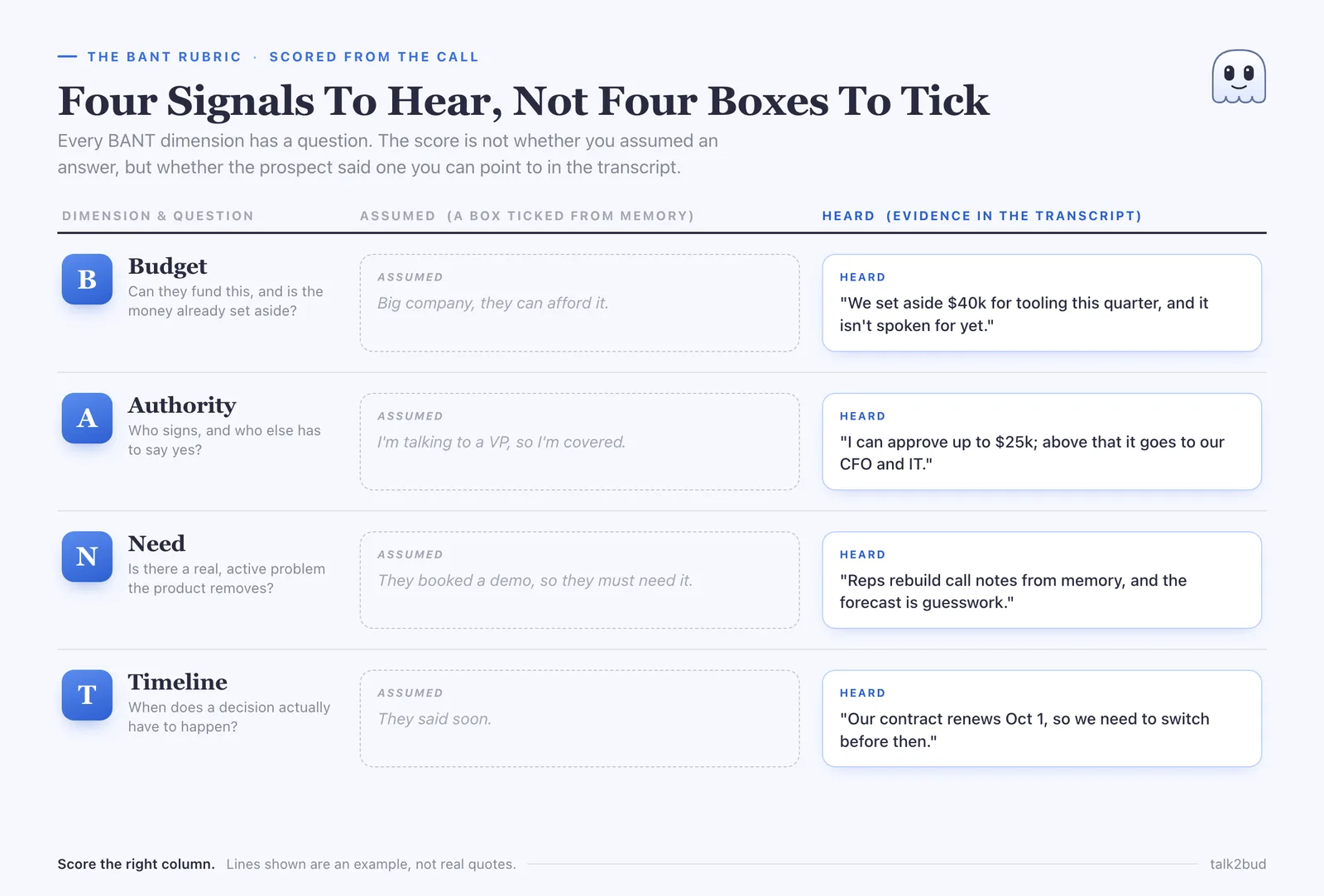
Budget. The question is whether they can fund this, and whether the money is already set aside. "Big company, they can afford it" is an assumption, not an answer. The evidence sounds like a buyer naming money that already exists: "we have budget approved for tooling this quarter, and it isn't claimed yet." Reps skip Budget because it feels rude, so a softer version works: ask what size of spend would need sign-off, and who signs at that size. That one question scores Budget and Authority at once.
Authority. The question is who signs, and who else has to say yes. Talking to a VP is not the same as talking to the person who can approve the spend. The evidence is a sentence like "I can approve up to twenty-five thousand; above that it goes to our CFO and IT." That single line hands you the approval ceiling, the next two stakeholders, and a heads-up that a security review is coming. Note who is absent from the call, because the person not in the room is the one who kills deals in week six.
Need. The question is whether a real, active problem exists that your product removes. A booked demo is interest, not need. The evidence is the buyer describing the pain in their own words: "reps rebuild call notes from memory, and the forecast is guesswork." Need is strongest when the buyer puts a cost on doing nothing. If the only person who can describe the problem is you, there is no need yet, there is a pitch.
Timeline. The question is when a decision actually has to happen, and why then. "Soon" is not a timeline; a compelling event is. The evidence is a dated reason: "our contract renews October first, so we need to switch before then." A real timeline has a forcing function behind it, a renewal, a launch, a budget that expires. Without one, a deal with perfect Budget, Authority, and Need still drifts for two quarters.
A Worked Example: Scoring The Northwind Call
The call below is an example built to show the method, not a real account. A rep at a sales-software company runs a thirty-four minute discovery call with Dana, a sales-ops lead at Northwind Logistics. Here is the call, scored line by line.
Dana booked the call after her team missed a forecast. Twenty minutes in, she says her team writes up calls from memory and the pipeline is "held together with guesses." Later: "we set aside forty thousand for tooling this quarter." On authority: "I can greenlight up to twenty-five, over that it's our CFO, and IT has to clear anything that records calls." On timing: "our current tool renews October first, and I'm not renewing it."
Now the score:
- Need: strong. Dana described the problem before the rep pitched anything, and tied it to a missed forecast. That is the line between a need and a nice-to-have. She quantified the cost, a blown quarter, which is the strongest form of Need evidence.
- Budget: partial. Forty thousand is allocated and unspoken for, which is real. But the rep does not yet know whether the tool fits under Dana's twenty-five thousand approval line or trips the CFO threshold. Budget exists; its ceiling is unconfirmed.
- Authority: partial, and honest about it. Dana can approve part of the range herself. Two stakeholders are named and absent: the CFO for spend, IT for the recording-security review. A rep scoring from memory writes "spoke to decision-maker, looks good." A rep scoring from evidence writes "economic buyer and security reviewer not engaged yet."
- Timeline: strong. October first is a dated forcing function with a reason behind it. Dana volunteered it, and she volunteered that she will not renew, which is a compelling event, not a polite "soon."
The read that falls out of this is specific: a real opportunity with strong Need and a hard Timeline, gated by two unengaged stakeholders and an unconfirmed budget ceiling. The next call is not a demo; it is getting the CFO and IT in the room before October. A generic scorecard marks this "BANT complete, advance to demo" and loses a month.
Notice what made the score trustworthy: every line points back to something Dana actually said. Swap the evidence for the rep's after-the-fact impression and the same call scores "hot lead, all four green," which is exactly how a strong opportunity gets mishandled.
BANT vs MEDDIC vs CHAMP
Qualification did not end with BANT, and for some deals BANT is the wrong tool. Two well-known alternatives were built to fix specific BANT failures.
| Framework | Stands for | Born | Best when |
|---|---|---|---|
| BANT | Budget, Authority, Need, Timeline | IBM, 1950s | Short, simple cycles; one or two buyers; fast triage |
| MEDDIC | Metrics, Economic buyer, Decision criteria, Decision process, Identify pain, Champion | PTC, 1996 | Complex enterprise deals; many stakeholders; long cycles |
| CHAMP | Challenges, Authority, Money, Prioritization | around 2007 | Consultative sales that should open on the problem, not the budget |
MEDDIC came out of Parametric Technology Corporation in 1996, where Dick Dunkel and Jack Napoli needed to qualify large deals across big buying committees (MEDDICC). It adds the two things BANT never had: a Champion inside the account, and an explicit map of the decision process. CHAMP, coined around 2007 and popularized by InsightSquared, keeps BANT's four dimensions but reorders them, leading with Challenges and pushing Money to last, because opening a cold call on budget loses the meeting a problem-first opener would have kept (Copper).
The honest read: BANT is the fast triage, MEDDIC is the enterprise operating system, and CHAMP is BANT with better manners. Plenty of teams triage with BANT early and switch to MEDDIC once a deal turns real.
Where BANT Breaks (And When Not To Use It)
BANT gets criticized a lot, and most of the criticism is fair. Three failure modes matter.
It was built for a buying world that no longer exists. BANT assumes a decision that runs through one person. Gartner's research puts the typical buying group for a complex B2B solution at six to ten decision makers, each doing their own research (Gartner). A framework with a single Authority box cannot represent a committee of eight. That gap is what MEDDIC's Champion and decision-process fields were invented to close.
Budget-first cuts good deals early. When the first thing a rep qualifies on is money, promising conversations get killed before the need is even established. This is precisely why CHAMP moves Money to last. Leading with budget also reads as seller-centric, the most common charge against BANT: it qualifies for the seller's convenience, not the buyer's problem.
It rots into a checkbox. Done badly, BANT turns discovery into an interrogation, four questions fired to fill four fields. HubSpot's own guidance is to "earn the right to talk BANT by focusing first on insight, education, and pain discovery," and to keep the questions flowing "together in a conversation" rather than a checklist (HubSpot).
So when should you not use BANT? Graduate past it on enterprise deals with large buying committees, where MEDDIC or MEDDPICC carries the complexity BANT drops. Reorder it toward CHAMP for consultative, problem-first selling, where a budget question on the first call is premature. And drop the interrogation entirely for inbound or product-led motions, where a prospect already evaluating does not want to be quizzed on their timeline. BANT is a triage tool. Run as a full sales methodology, it breaks.
Scoring BANT From What Was Actually Said
Every honest word above depends on one thing you probably do not have: an accurate record of what the prospect said. Scoring BANT from memory is the original sin, and notes typed during a live call are memory with extra steps. Here is how to score it from evidence instead, using talk2bud on the discovery call itself.
- Capture the call where it happens. talk2bud records the discovery call from your Mac's system audio, so nothing joins the meeting as a participant and no bot shows up in the attendee list. Recording without a bot is not the same as recording in secret: the honest step is still to tell the room you are recording, and talk2bud's consent flow is explicit for exactly that reason. It runs on Apple Silicon Macs, in English, and is built to capture the conversation, not to fill in your CRM.
- Read the call against a sales Lens. A Lens is a small analysis playbook for a meeting type. Pick the built-in Sales call Lens, or write your own that scores Budget, Authority, Need, and Timeline, and talk2bud evaluates the transcript against it when the call ends.
- Get the read, with the receipts. Instead of a checkbox from memory, you get the four signals tied to what was actually said, plus the next steps with an owner and a date. The gap the score exposes, an unengaged economic buyer, an unconfirmed ceiling, becomes the agenda for the next call.
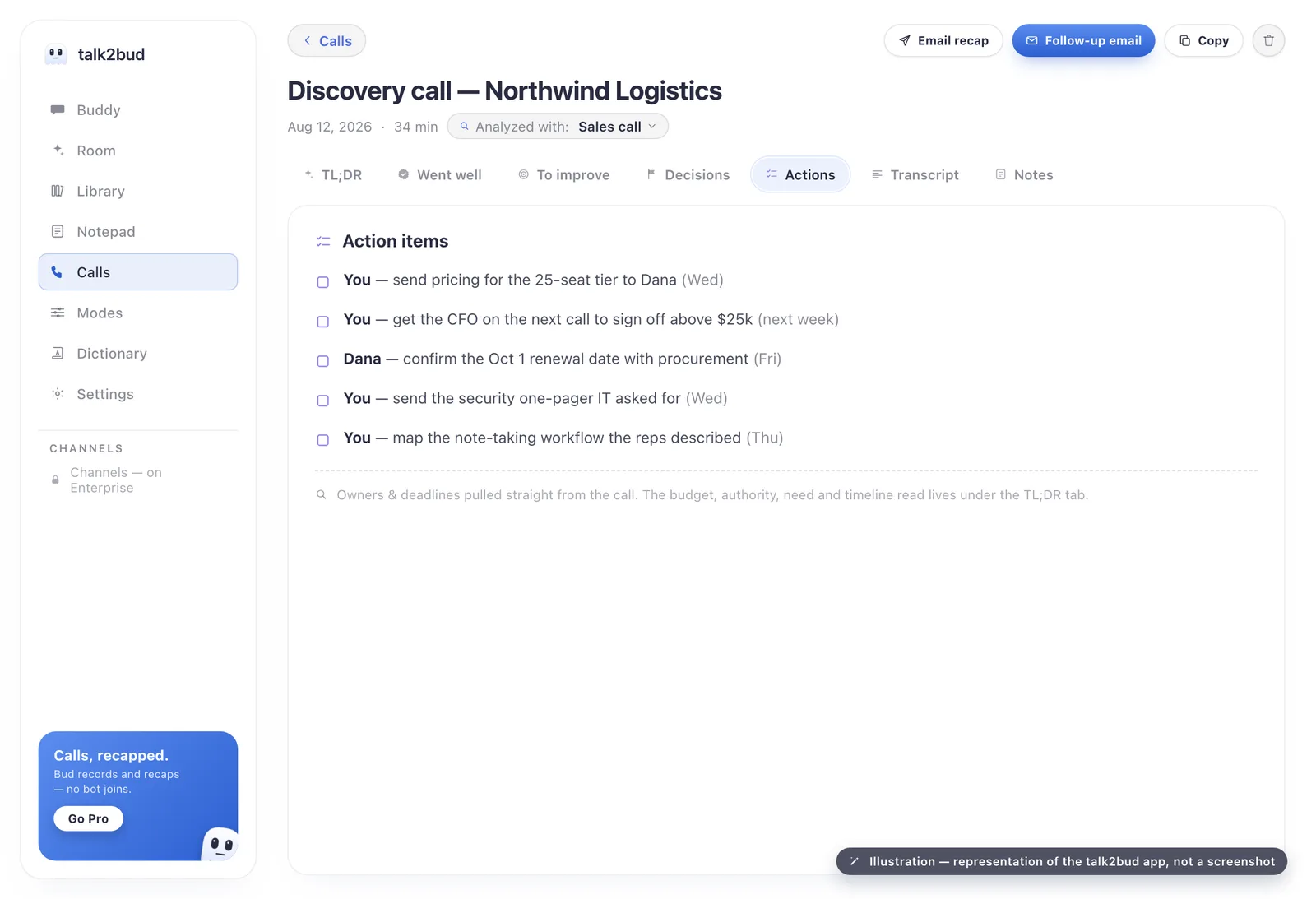
For a one-on-one, that read stays between the two people in the conversation and never lands in a shared channel by default. You can capture the discovery call from your Mac without a bot in the room and see the whole flow.
Frequently Asked Questions
What does BANT stand for?
BANT stands for Budget, Authority, Need, and Timeline, the four signals in a sales qualification framework used to decide whether a lead is worth pursuing. Budget asks whether the prospect can fund the purchase, Authority whether they can approve it, Need whether a real problem exists, and Timeline pins down when the decision has to land. A few sources spell the T as Timing, but it points to the same buyer decision window.
Who created BANT?
BANT was created by IBM, whose sales team formalized it in the 1950s to qualify leads for large, planned purchases. It spread widely because it matched an era of perpetual software licenses and centralized, single-buyer decisions. IBM's framework has since been taught to generations of salespeople and shaped later methods like MEDDIC and CHAMP.
Is BANT outdated?
BANT is often called outdated, and for complex deals the criticism holds: it assumes a single decision-maker, while Gartner finds the typical B2B buying group runs six to ten people. BANT is not dead, though, because it still does fast triage well and stops reps chasing leads that were never going to close. Most teams now use BANT for early qualification and a deeper framework like MEDDIC once an enterprise deal is real.
What is the difference between BANT and MEDDIC?
BANT is a four-part framework (Budget, Authority, Need, Timeline) built for quick qualification in short sales cycles, while MEDDIC is a six-part framework (Metrics, Economic buyer, Decision criteria, Decision process, Identify pain, Champion) built for complex enterprise deals. MEDDIC adds a Champion and an explicit decision process, the two things BANT leaves out. A common pattern is BANT at the top of the funnel and MEDDIC once a buying committee is involved.
How do you qualify a lead using BANT?
To qualify a lead with BANT, you gather evidence on four signals during the conversation: whether the budget exists and who controls it, who can approve the spend and who else must sign off, whether a real and active problem exists, and when a decision has to be made. The trick is to score each signal from what the prospect actually says, not from an after-the-fact impression. A gap in any signal is not a disqualification; it tells you what the next call has to resolve.
Try It On Your Last Call
BANT meaning is the easy half; scoring BANT honestly is the whole job. The single next step is small and revealing: take your last discovery call, and instead of trusting your notes, check how many of the four signals the prospect actually said out loud, and how many you assumed. Run that one call through a Sales call Lens and read the gap. If Need and Timeline were real but the economic buyer was never in the room, the framework did its job, and now you can see the deal clearly enough to fix it. For more from the sales desk, browse the talk2bud sales guides.
Verified August 2026 against Pipedrive, TechTarget, HubSpot, Gartner, MEDDICC, and Copper, linked above. This is a general explainer of a widely used sales framework, not a claim about any one company's results.