Meeting feedback sample: four forms and the questions to cut
Four copyable versions, a table that picks one, a field by field breakdown and a filled example, plus the questions to delete because the call already answered them.
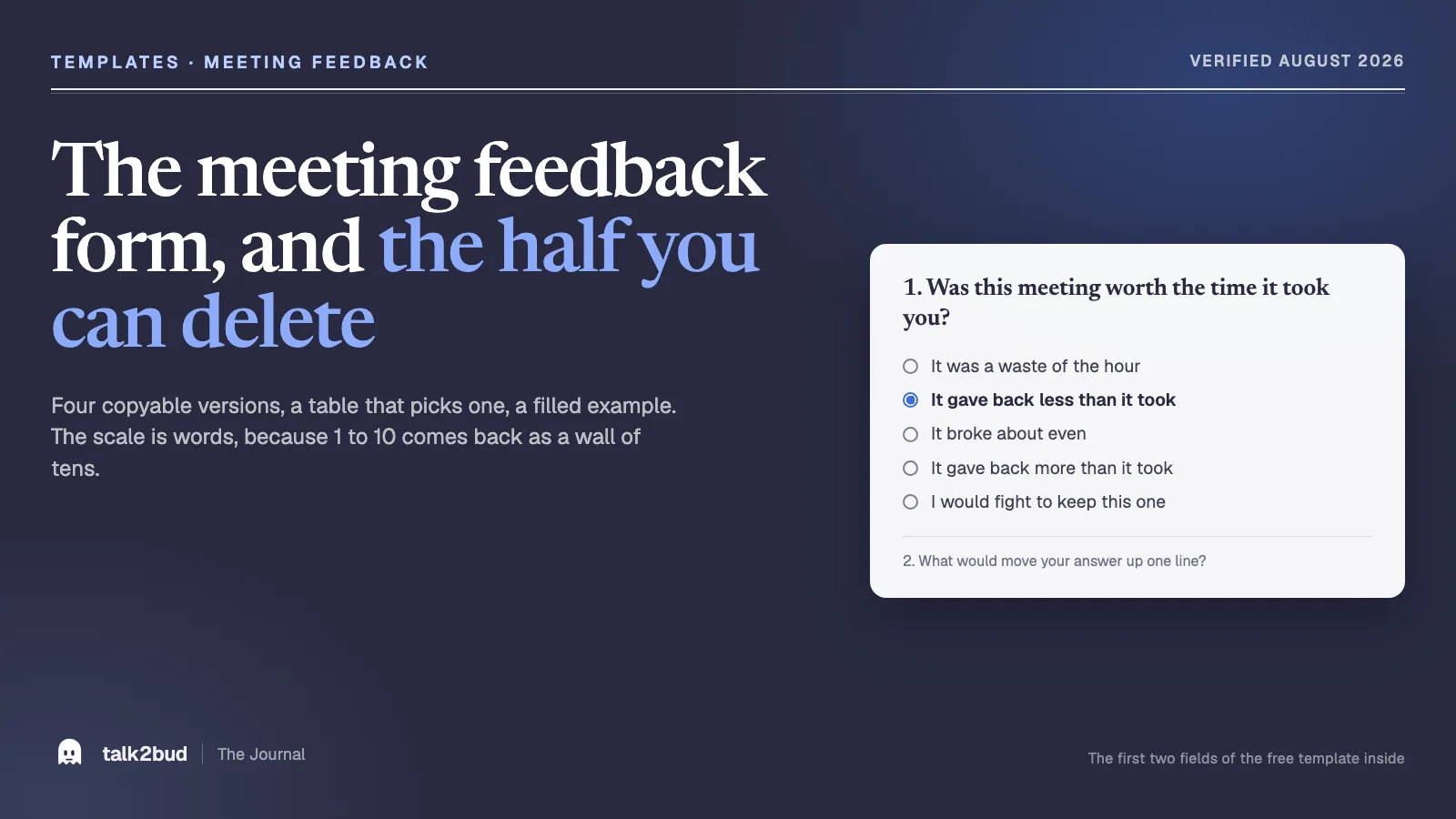
Meeting Feedback Sample: The Form, And The Half You Can Delete
Last quarter's form asked ten questions and came back as a wall of top marks, because "rate this meeting from 1 to 10" has one honest answer and one polite one. The meeting feedback sample below asks five, none of them numbered, and hands the rest of the old form to the recording that was in the room anyway.
A form like this works when it asks only what attendees know better than a transcript does: whether the hour was worth theirs, and whether they could say what they came to say. Four copyable versions follow, with a table that picks one, a breakdown of every field, and an example filled in.
That split is the design. Researchers at Microsoft published 15,000 real meeting ratings at CSCW in 2024, and 82% of respondents picked five stars for effectiveness. A rating scale mostly measures manners. The questions that fail hardest, about decisions and owners, are answered by the call itself, which is where talk2bud reads them from.
The Meeting Feedback Form
Here it is, whole. No gate in front of it, no address to leave first.
Feedback · {meeting name} · {date}
Thirty seconds. Answers go to {name}. {Names shown / names hidden}.

1. Was this meeting worth the time it took you?
   ( ) It was a waste of the hour
   ( ) It gave back less than it took
   ( ) It broke about even
   ( ) It gave back more than it took
   ( ) I would fight to keep this one on the calendar

2. What would move your answer up one line?
   {one sentence}

3. Could you say the thing you came in wanting to say?
   ( ) No, and I stopped trying
   ( ) Only part of it
   ( ) Yes, once
   ( ) Yes, any time I wanted

4. Keep doing / change next time
   Keep: {one sentence}
   Change: {one sentence}

5. Anything you would rather say to {facilitator} privately? (optional)
   {one sentence}
Four questions you expect are missing on purpose. What got decided, who owns what, whether the agenda was covered, whether everybody got a turn: those are matters of record, and a room reconstructing them from memory at 6pm is the least reliable instrument available. Atlassian's survey of 5,000 knowledge workers found 54% frequently leave a meeting without a clear idea of next steps or who owns which task, which makes asking those people a strange way to find out. That half belongs to the recording, and talk2bud reads it off the call so the form can spend its five questions on what no transcript knows.
The scale in question 1 carries the same study behind it. Trading the star rating for worded options made each answer carry 44% more information, measured as Shannon entropy, with no real change in how many people replied (18.1% against 17.2%). Words cost nothing and buy a distribution instead of a ceiling.
Download The Meeting Feedback Sample
Every version here, the decision table and the filled example, on paper: download the meeting feedback template (PDF, 4 pages, 312 KB). Published under CC BY 4.0, so print it, edit it, drop it in your onboarding doc, as long as talk2bud gets the credit.
Three More Versions For Three Kinds Of Meeting
Each one has a different job. The header line, with the date and the visibility rule, goes on all three.
The twenty-second pulse. For the recurring meeting that lands on the calendar every week.
{Meeting} · {date}
Worth the hour?
[ ] waste   [ ] under   [ ] even   [ ] over   [ ] protect it
What moves that one step right?
{one sentence}
Two questions is the right size for something people see four times a month. The long version is for the quarter you mean to redesign the meeting.
The large session. All-hands, town hall, training, anything past a dozen people.
{Session} · {date}
1. One thing you will repeat to someone who was not here:
   {one sentence}
2. What question did you not get to ask?
   {one sentence}
3. Did the hour pay for itself?
   [ ] no  [ ] partly  [ ] evens out  [ ] yes  [ ] keep it
Question 1 tests retention rather than satisfaction, the only thing a broadcast meeting can honestly claim. Question 2 exists because almost nobody speaks in a room that size: the CSCW study found a person seven times more likely to talk in a meeting with fewer than eight people. For the rest, this is the only channel on offer.
Feedback for the person who ran it. A different direction, and the one most template pages fold into the first.
Situation: {when and where, specific. Never "in meetings lately".}
Behavior:  {what you saw or heard, in facts a camera would catch}
Impact:    {what it did to the meeting, and your honest reaction}
Intent:    {optional} What were you hoping to accomplish with that?
That is SBI, from the Center for Creative Leadership, whose wording for the middle line is "describe the actual, observable behavior. Keep to the facts." The fourth line is the SBII extension, which closes the gap between what someone meant and what landed. Send it to the person, never to a group thread. Feedback about a meeting can be pooled; feedback about a person cannot, which is the rule talk2bud applies to a 1:1, where the analysis stays with the two people in it.
Which Version To Send, And When
| Your situation | Send | Why this one |
|---|---|---|
| First time asking, or the meeting is up for review | The five-question form | Long enough to act on, short enough that people finish it |
| Weekly or fortnightly recurring meeting | The twenty-second pulse | Same faces, same form, four times a month |
| Town hall, training, past twelve people | The large session form | Most of the room never spoke, so the unasked question is what to collect |
| Someone ran the meeting and asked how they did | The SBI note | A pooled score tells that person nothing they can change |
| Kickoff, and you want to know whether people left aligned | The five-question form plus "in one sentence, what is this project for?" | Alignment shows up by comparing the answers to each other, never to a scale |
| You want to know what was decided and who took what | None of these | A form is the wrong instrument for a matter of record. Read it off the call, which is what a Lens in talk2bud returns |
What Each Question Is Doing
The header line. Names shown or hidden, decided before you send and printed on the form. People calibrate honesty to what they believe about visibility, and an unstated rule gets guessed, usually pessimistically.
Question 1, the worth-the-time line. This is ROTI, Return on Time Invested, with the numbers stripped out. Lucid Meetings defines its scale in words too, where 0 is a complete waste and 3 is the sweet spot, the meeting that gave back more than it cost. Worded options force a choice between described states instead of a vague spot on a line.
Question 2, the follow-up. ROTI's own version reads "what would it take for you to improve your rating by one point?", and it turns a rating into an instruction. A rating on its own tells you the meeting was mediocre and nothing at all about Monday.
Question 3, the speaking question. In the CSCW measurement, vocal participation was the strongest single correlate of feeling included, worth about 8 percentage points, and meetings under eight people were 50% more likely to be rated inclusive. It asks about ability rather than enjoyment, because "did you feel included" invites a compliment.
Question 4, keep and change. Plus/Delta, and the order matters: what worked is named first, and the change is framed as a change rather than a complaint, which is what gets it written down at all.
Question 5, the private line. Some of what people want to say is about a person in the room. Give it a route that is not the group summary, or it curdles.
The Form, Filled In
An illustrative example. The team, the meeting and the answers are invented for this page.
Feedback · Monday Ops Sync · 11 Aug 2026
Answers go to Priya. Names hidden.

1. Worth the time?     gave back less than it took
2. Moves it up a line? Start on last week's items. Twenty minutes went
                       into context that three of us already had.
3. Could you speak?    only part of it
4. Keep:   the five-minute demo at the end. It is the only place I see
           what the other pods shipped.
   Change: nine people, six of us watching. Give pricing its own call
           with the four people it touches.
5. Private: the interruptions run one way, and it is the same two voices.
Three usable things came back, and not one of them is a score. The meeting has a fixable opening, and that repair lives upstream in the agenda, rewritten as the questions the hour has to answer. It has a structural problem, nine people for an item that concerns four, and the research says shrinking the room is the highest-yield change on offer. And it carries a dynamic that would never surface in a group retro, which is why field 5 is private.
Getting A Team To Fill It In Twice
Leave a week between asks. The critical cool-down point measured in the study was about seven days for one person: closer than that, quality drops, and whoever sits in the most meetings answers least and hands out the most top marks.
Make the follow-up a required field. Dropping responses that arrived in under four seconds cut the share of top marks on both questions by 14 percentage points, which is a fair measure of how much of a fast tick is reflex. One required sentence costs the reflex answer more than it costs the real one.
Report back one named change within the week. "You said the first twenty minutes were context, so we now open on last week's items." A form that visibly changes nothing gets answered once.
Four Ways A Feedback Form Goes Quiet
Numbers where words belong. A 1 to 10 scale on a meeting yields a pile at the ceiling and a decimal place of movement per quarter.
Questions the transcript already answered. They read as a memory test, and people who fail one skip the next.
Weak: Were action items clearly assigned to owners? Strong: What would you cut from this meeting first?
Anonymous in name only. A form that promises hidden names and then asks which pod you sit in, on a call with nine people, is a form everyone correctly reads as signed.
No visible consequence. Replies fall off fastest between the first send and the second, and the variable in between is whether anything happened.
Using talk2bud On The Meeting You Just Asked About
The form covers the half only the people know. Here is how the other half comes back, without anyone typing notes while the meeting is still going.
Meet the way you already meet. Zoom, Google Meet, Teams, whatever the invite says. talk2bud captures the conversation from your Mac's system audio, so nothing joins as a participant and the attendee list stays the length it was. Capturing without a bot is not a way to capture in secret: precisely because nothing announces itself, saying it out loud is the step that keeps the recording honest, and the app treats consent as an explicit part of the flow for that reason. The default is moving the same way, and Google now lets admins require participants to actively agree before a Meet call is recorded.
Pick the Lens for that kind of meeting. A Lens is a short analysis playbook for one type of call: the weekly team sync, the kickoff, the 1:1. You select it before the meeting or while it runs, and you can write your own, which is how a team's definition of a good meeting gets applied the same way every week.
Read back the half you deleted. When the call ends, talk2bud evaluates the transcript against that Lens and returns what the playbook asks for: what was decided, who took what and by when, what got covered and what quietly did not. A 1:1 stays between the two people in it unless you send it to a team Channel on purpose.
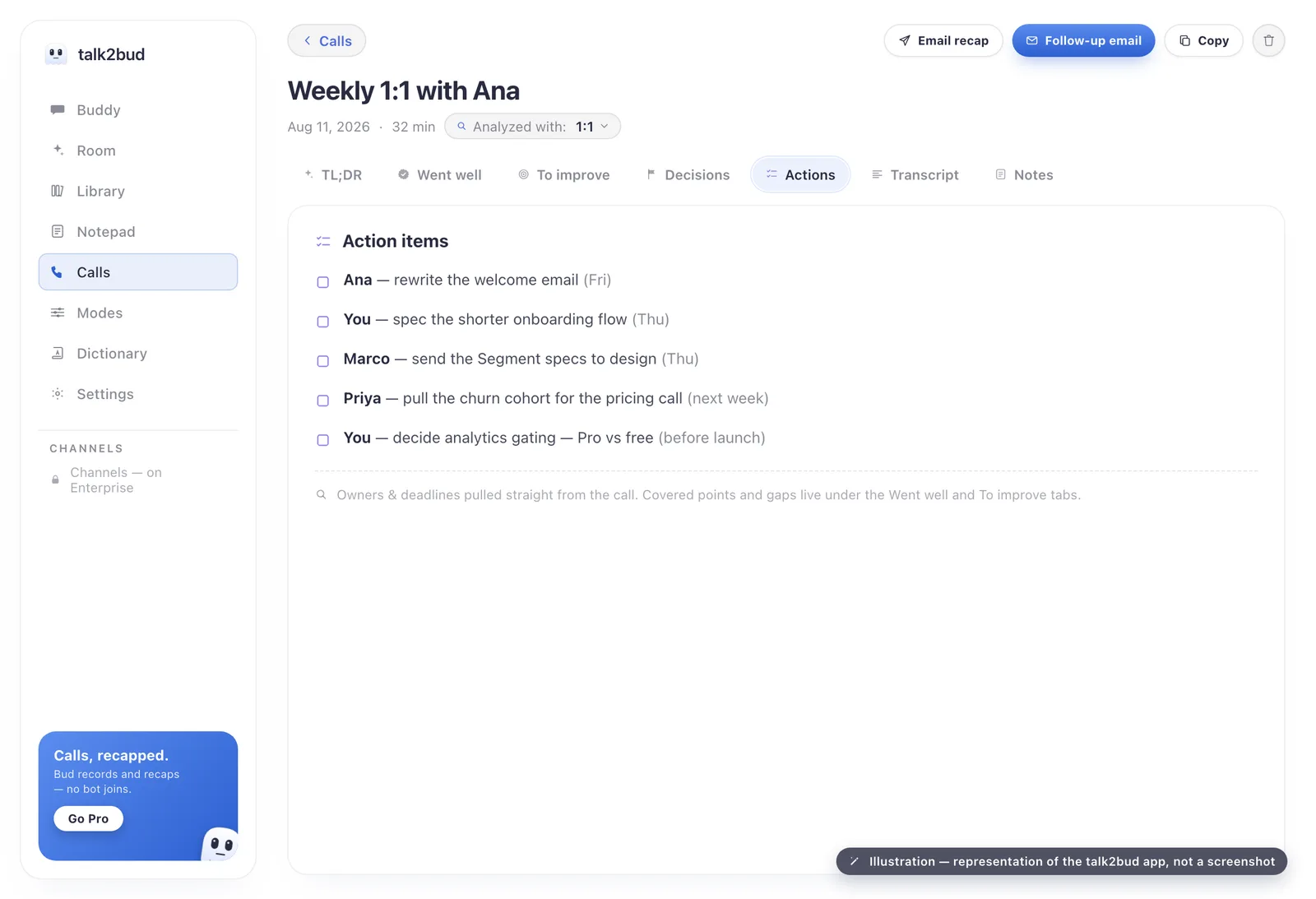
talk2bud runs on a Mac, in English, and it is built to read the conversation rather than to run your survey tool. That focus is what lets the form stay five questions long: put the record where a machine can keep it, and what you ask a human is what only a human can answer. If capture is the part you have not solved, the guide to recording a meeting without a bot in the room covers it end to end.
Questions People Ask About Meeting Feedback
What is a meeting feedback survey?
A meeting feedback survey is a short form sent to attendees after a meeting, asking whether the time was worth it and what should change next time. The useful ones stay under five questions and use worded answer options instead of a 1 to 10 scale, because numeric meeting ratings pile up at the ceiling: in a study of 15,000 real meeting ratings published at CSCW in 2024, 82% of respondents chose five stars for effectiveness. Decisions, owners and agenda coverage belong to the meeting record rather than to the survey, which is the split talk2bud is built around.
How do you write feedback after a meeting?
Write it in three parts: the situation, the behavior you observed, and the impact it had. That structure is the SBI model from the Center for Creative Leadership, and it keeps feedback specific enough to act on, as in "in Monday's sync, the pricing item got two minutes, so we left without a decision". Feedback about a person goes to that person; feedback about the meeting goes to whoever runs it.
How many questions should be included in a post-meeting survey?
Two to five, depending on how often the meeting repeats. A weekly meeting gets two, because attendees will see the same form four times a month, and research on survey fatigue puts the cool-down point at roughly seven days between requests to one person. A quarterly review can carry five, including one open question asking what would raise the rating a level.
When is the best time to send a post-meeting survey?
Send it as the meeting ends, while the conversation is still in the room rather than remembered. Vendor guidance commonly puts the window at 24 to 48 hours, and the shorter that gap, the less you collect a memory of a memory. The timing rule with real evidence behind it concerns frequency rather than delay: leave about a week between asks to the same person, the cool-down point measured in the CSCW study of 15,000 meeting ratings.
How can we increase response rates to post-meeting feedback surveys?
Keep it under five questions, use worded options instead of stars, space the asks about a week apart, and report back one named change after each round. In the CSCW study, replacing a five-star scale with verbal labels raised the information in each answer by 44% while the response rate held steady at 18.1% against 17.2%, so the cheaper form is also the more informative one. Cutting the questions a recording already answers, the half talk2bud returns from the call itself, shortens the form without costing you anything.
Verified August 2026 against the sources linked above: the CSCW 2024 measurement study, Atlassian's survey of 5,000 knowledge workers, the Center for Creative Leadership's SBI page, Lucid Meetings on ROTI and Plus/Delta, and Google's Workspace announcement on explicit consent. This is document review, read on 13 August 2026, and every number here carries the page it came from.
What To Delete Before You Send It
Open the feedback form your team uses today and strike every question that is a matter of record: the decisions, the owners, the agenda coverage, the turn-taking. Whatever survives is the form you send after the next meeting, and it will be shorter and better answered than the one you have now, with the deleted half coming back from the call itself, read against a Lens. The other meeting templates in the library are built on the same split.