Cold email template for meeting: five versions, then the call
Five copyable versions, a decision table, a filled example, plus the harder half nobody scripts: the meeting the email books, and how to read it back.
The Cold Email Template For A Meeting, And What Happens After Yes
Gong Labs read 304,174 cold emails and found the specific day-and-time ask books a meeting only 15% of the time while the thread is still cold. A cold email template for a meeting works better with the ask as a variable, not a default. The five below ship it that way, with a table to pick one and the legal fields already inside.
The email is the cheap part. Its whole job is to earn a reply that turns into a meeting, and the meeting is where the account is actually won, lost, or half-remembered by Thursday. Most template pages hand you the email and leave you at "yes." This one carries the thread further: the template that books the call, then how to keep the call itself from leaking.
The Template
Copy it. There is no form in front of it and no email address to hand over.
Subject: {the specific thing they shipped}

Hi {first name},

{One line that proves you looked. A number, a date, a job posting, a
changelog entry. Something that was not true of them last quarter.}

{One sentence naming the problem that fact usually creates, written the
way they would say it out loud.} {Two named companies in their category}
solve it by {the mechanism, in under ten words}.

{The ask. Interest by default. The table below tells you when to swap it.}
Should I send the two-minute version of how {company} did it?

{Your name}
{Role}, {company}
{Street, city, postcode}
Reply "stop" and I am done writing.
Two lines in there get skipped most often, and both are legal requirements in the United States rather than politeness: the postal address and the exit. The FTC's own compliance guide puts it flatly: "The law makes no exception for business-to-business email."
Download The Cold Email Template Pack
All five templates, the decision table and the filled example, on paper: download the cold email template pack (PDF, 3 pages, 303 KB). Published under CC BY 4.0, so reprint it, edit it and hand it around as long as you credit talk2bud.
Four More Versions Of The Same Ask
Each one changes the opening move, not the shape. The signature and postal block from the first template goes at the bottom of all four.
The referral. When a mutual name will do the persuading for you.
Subject: {referrer first name} said you own {the thing}

{First name}, {referrer full name} at {referrer company} pointed me here.

{The context the referrer gave you, close to their words, so the
connection is checkable rather than claimed.}

{What changed for the referrer, with the number and the months it covers.}

Should I send you that same breakdown, or is this the wrong quarter?
The two-line ask. For senior titles who read on a phone between meetings.
Subject: {five words, lowercase, no pitch}

{First name}, {one sentence: the outcome, the number, the customer}.

Worth a look?
The trigger. When something happened this month that creates the problem you fix.
Subject: {the event}, and the part nobody staffs for

Hi {first name},

Saw {the round, the hire, the migration, the launch} on {where, with the date}.

Teams doing that usually run into {the second-order problem} about {a
realistic number of weeks} later. {Your company} cuts that to {number}.

Curious what the first thirty days looked like at {named customer}?
The close. The last message in a sequence, and often the one that gets answered.
Subject: closing the loop on {topic}

{First name}, I have written twice about {topic} and heard nothing, which
is a perfectly good answer.

Before I file this away: was it the timing, the topic, or me? One word
covers it, and I will act on whichever you pick.
Which Cold Email Template Fits Your Situation
| Your situation | Send | Why this one |
|---|---|---|
| First touch, no warm path, cold list | The template above, interest ask | Gong's data puts the interest ask ahead at the cold stage. You are selling the reply, not the calendar slot |
| You share a real connection | The referral | Credibility arrives before your pitch does, and one message to the referrer verifies it |
| Something changed there in the last 30 days | The trigger | Recency is the personalization a merge field cannot fake |
| VP and above, or anyone with a 40-message inbox | The two-line ask | Under 40 words fits a lock-screen preview whole, so the decision happens before the tap |
| They already agreed to talk, or you are mid-cycle | The template above, meeting ask | Once the deal is open, Gong's read of 304,174 emails puts the specific day-and-time ask at 37%, against 15% cold |
| Message three or four, silence so far | The close | A one-word exit is the cheapest thing you can offer someone who owes you nothing |
What Each Line Is Doing
The subject. It names the thing, not the benefit. "Your Q3 hiring page" beats "Quick question" because only someone who opened a browser could have written the first one. Most people write the subject last, in a hurry, after the body has drained their attention.
The first line. One fact, dated, about them. Any sentence that survives a find-and-replace of the company name has failed this field. Skip the compliment, which is the most-copied opener in outreach and the most burned.
The reason line. Templates collapse into vendor language here. Write the problem the way the reader describes it to a colleague, then name two companies like theirs that got past it. Two names beats a logo wall because the reader can picture both.
The ask. Interest or meeting, per the table, and exactly one of them. The ask is not the prize; the reply is, and the meeting the reply becomes is where the selling actually happens. An email closing with a question and a calendar link offers two doors, and the reader picks neither.
The signature. Role, company, postal address, exit. Four lines that make the message business correspondence instead of an anonymous blast.
The Three Fields The Regulators Put Inside The Email
These are the parts you cannot personalize away. They come from the regulators' own pages, and describe what belongs in the email rather than what is lawful for your company to send.
A real postal address. Required by the CAN-SPAM Act for commercial email, business recipients included. Each violating message carries penalties of up to $53,088 in the FTC's published figure, and a street address, a registered PO box or a private mailbox all qualify.
A way out that works. The FTC requires the opt-out mechanism to stay live for at least 30 days after you send, and requires you to honor a request within 10 business days. In the UK, the ICO's PECR guidance adds that you "must not disguise or conceal your identity" and must give a valid contact address for people to unsubscribe. If you send more than 5,000 messages a day to Gmail accounts, Google's sender guidelines have required one-click unsubscribe plus a visible unsubscribe link in the body since 1 February 2024.
A From line and a subject that match the message. Both are named requirements in the FTC guide, and the ICO's version of the same idea is the ban on concealing who you are.
One rule is worth knowing before you build a list: the ICO says you may email a corporate body, while sole traders and some partnerships are "treated as individuals" and need consent. That page currently carries a notice that the guidance is under review following the Data (Use and Access) Act, so it is worth a fresh read rather than a screenshot from last year.
This section describes what the regulators' own pages require, not legal advice for your company. Cross-border B2B rules under the GDPR and ePrivacy vary by country and keep changing, so if you send into the EU or the UK at any scale, confirm your specific setup with a qualified attorney before you rely on it.
The Template, Filled In
Illustrative example. The company, the person and the numbers below are invented for this page.
Subject: your new Cologne warehouse

Hi Marta,

Your careers page posted three warehouse ops roles in Cologne on 4 August,
all reporting to the same manager.

The teams I work with say the second site is where their stock counts stop
matching, usually around week six, because two warehouses run two habits.
Bergmann Logistik and Nordfracht fixed it by locking one counting cadence
across both sites before the second one opened.

Want the two-minute version of how Bergmann set that up?

Ana Ferreira
Ops lead, Kettle Systems
14 Rua das Flores, 1200-192 Lisbon
Reply "stop" and I will not write again.
Three deliberate choices in there. The date makes the research checkable. Warehouse language carries the problem, and software is never mentioned. Marta's reply costs one word, and no calendar appears anywhere, because the meeting is what happens after she says yes to something smaller.
Notice that the exit line differs from the one in the first template. The FTC requires a working opt-out mechanism, not a fixed sentence, so word it however you would say it.
Keeping The First Line Alive At Volume
A template decays the moment it runs at scale, and it decays from the top down. The first line is the only part that must be original every time, and it is the part people stop writing around email eleven.
Three habits keep it alive. Cap the batch at what you can research, since Woodpecker's read of its own platform traffic shows lists under 50 contacts replying at 5.8% against 2.1% for lists over a thousand. Give the first line a named owner instead of leaving it to whoever has the sequence open. Write that line before you open the template, so the fact leads and the frame follows.
If typing the same opener thirty times is what kills it, stop typing it. talk2bud has an email mode that turns what you say into finished text in the field you are focused on, so you can speak the first line in your own words and it lands as writing, not as a transcript. Spoken sentences rarely sound like a merge field, because nobody speaks in merge fields.
Using talk2bud On The Meeting Your Email Just Booked
The reply lands, you settle on a time, and the part every cold-email article skips begins. The template earned you a seat. The meeting is where the account gets decided, and a first outreach call has a habit of ending with three commitments nobody wrote down. Here is how talk2bud takes that call off your hands so you can actually listen.
Get on the call the way you already do. Zoom, Google Meet, Teams, or a phone flat on the desk. talk2bud captures the conversation from your Mac's system audio, so nothing joins the meeting as a participant and no bot shows up in the attendee list. The capture runs on your own machine, which means the consent step is yours to say out loud, the same honesty the email's opt-out line stands for, rather than a silent recorder in the corner.
Pick the Lens that matches the meeting. A Lens is a short analysis playbook for one type of call. For a first sales meeting that is a discovery Lens, either one you write or the discovery script your team already runs. You select it before the call or while it is happening.
Read the call back instead of your memory. When the meeting ends, talk2bud evaluates the transcript against that Lens and returns the analysis the playbook asks for: whether the questions got asked, what the prospect committed to, and the next step you agreed on. Because the transcript starts life on your Mac, a first call or a 1:1 stays between the two people in it unless you send it to a team Channel on purpose.
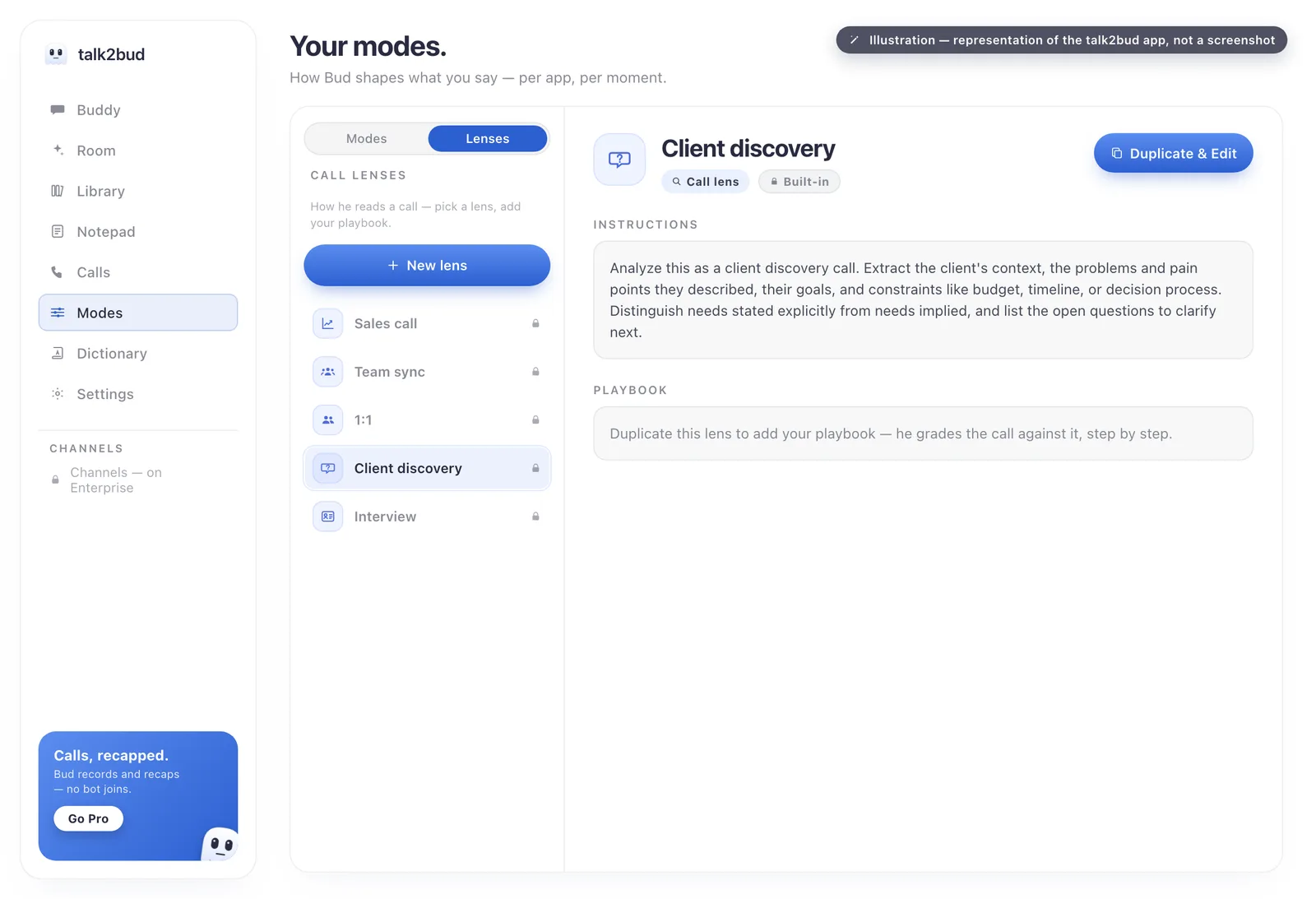
Illustration of the talk2bud app, not a screenshot: choosing the Client discovery Lens the app reads the meeting against.
talk2bud runs on a Mac, in English, and it is built to capture the conversation, not to write the email or replace your CRM. That focus is the reason the meeting comes back as something you can act on the same afternoon, instead of an hour you paraphrase from memory two days later. The cold email was the easy half. The meeting is the asset, and a Lens is how you stop letting it evaporate.
Five Ways A Good Template Still Fails
The compliment opener. The line that starts "I came across [Company] and was impressed by the work you're doing" is copied so widely that recipients name it on sight. One reader on Hacker News in June 2026 asked people to stop sending it: "It's a terrible cold email, I get so many of these every week."
Weak: I have been following Kettle Systems for a while and love what you are building in logistics. Strong: You opened a second warehouse in Cologne last month, and three ops roles went up with it.
Two asks in one email. A question plus a booking link reads as a choice, and the default answer to a choice from a stranger is nothing.
The unresearchable claim. "We help companies like yours scale" survives a find-and-replace, which means the reader has seen that sentence from four vendors this month.
No follow-up. Woodpecker's read of more than 20 million cold emails shows sequences that keep going, three to five steps, roughly doubling what a single send returns. A template used once is a template wasted.
The address left as a placeholder. Shipping {Street, city, postcode} to a real prospect is the one mistake on this list that is both embarrassing and, in the United States, a compliance failure.
Questions People Ask Before They Hit Send
Is cold emailing illegal?
Cold email is legal in the United States under the CAN-SPAM Act as long as the message carries accurate header information, a non-deceptive subject line, a valid physical postal address and a working opt-out that you honor within 10 business days. B2B messages get no exemption in the FTC's guidance, which prices each violating email at up to $53,088. Rules differ elsewhere: in the UK, PECR lets you email corporate bodies but treats sole traders and some partnerships as individuals who must consent first.
How long should my cold email be?
A first cold email works best between roughly 50 and 125 words, which is about five short lines: one fact about them, one sentence of problem, one line of proof, one ask, one signature. Anything longer usually means the writer is explaining the product instead of the problem. For senior recipients reading on a phone, the two-line version in the talk2bud template pack drops under 40 words so it fits a lock-screen preview whole.
What is a good cold email response rate?
Woodpecker's 2026 analysis of more than 20 million cold emails sent through its platform puts the average reply rate at 3.43%, down from 5.1% in 2024, with 5% to 10% counted as good and above 10% as excellent. Reply rate tracks list size closely: under 50 contacts averages 5.8%, while lists above 1,000 contacts average 2.1%. Judge a cold email template against those numbers rather than against a vendor case study.
How do I follow up if a cold prospect doesn't respond?
Send three to five follow-up steps in the same thread, each one adding a fact rather than repeating the ask, and finish the sequence with a close message that offers a one-word exit. Woodpecker's platform data puts three to five step sequences at an 8.3% reply rate against 4.1% for a single send. The close template in this article is written for that final step.
What is a good cold email structure?
A cold email that asks for a meeting has five parts in this order: a subject line naming a specific thing about the recipient, a first line proving you looked, one sentence describing the problem in the recipient's own language, a single ask, and a signature carrying your role, company, postal address and opt-out. The order matters because the reader decides during the first line whether the rest gets read, and because the ask is only there to open the meeting where the real conversation happens.
Verified August 2026 against the regulators' own pages and the platform datasets linked above. Reply-rate figures come from vendor platform traffic, the best public evidence available for cold email and still one company's numbers; the compliance requirements come from the FTC, the ICO and Google directly.
Which One To Send, And What To Do After Yes
If this is a cold first touch, send the interest ask and let the meeting come from the reply. If the deal is already open, switch to the specific day and time, because the same dataset that says 15% cold says 37% once you are in. If nothing has come back after three messages, send the close and let the person tell you which of the three reasons it was.
The next step is not a sixth template. Take the pack, pick one version from the meeting-template library, and write five real emails before you write a sixth. Then put the first meeting one of them books through a Lens, so the call comes back as an analysis you can act on instead of a memory you argue with later.