Employee self assessment comments: 90+ original examples
The lists online hand you phrases to copy. This page hands you a structure to fill with what you actually did, plus the honest way to find it.
Employee Self Assessment Comments: 90+ Original Examples That Don't Sound Generic
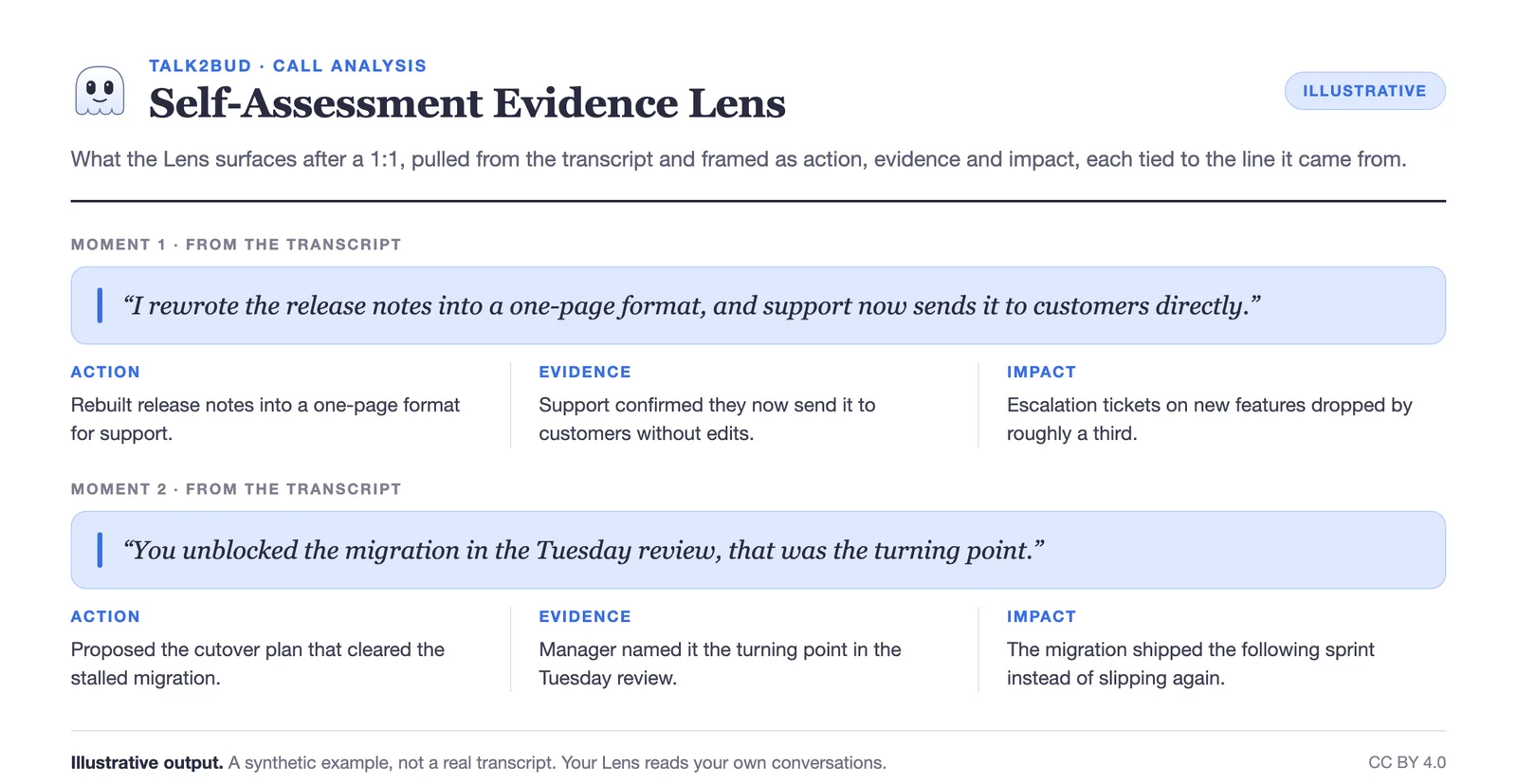
Last year you wrote "I communicated well with my team and consistently delivered quality work." This year you can write "I rewrote our release notes into a one-page format that support now sends to customers directly, which cut escalation tickets on new features by roughly a third."
The second line lands because it can be checked. That is the whole difference, and it is the reason a copied comment fails the moment your manager reads it. The one thing a reviewer can verify is whether the evidence is real, so a borrowed phrase with no fact behind it reads as exactly what it is.
The examples below are built to be replaced. Every one names a specific action, the evidence it happened, and the impact it created, so you can keep the shape and drop in your own facts. They are illustrative templates, not real quotes, and they are worth nothing until you swap in what you actually did. The harder half of the job, remembering what that was across six months of 1:1s and reviews, has an honest answer near the end of this page.
A strong self assessment comment names one specific action you took, the evidence that it happened (a number, a date, a named artifact, a piece of feedback), and the impact it had on the team or the business. Skip any of the three and the line turns generic. That structure, action then evidence then impact, is what the rest of this page teaches and supplies.
The Structure That Works: Action, Evidence, Impact
Take one weak comment apart and the pattern shows itself. "I'm a strong collaborator who supports the team" names no action (there is no how), gives no evidence (no source, no number), and shows no impact (nothing measurably changed). It could be pasted into any review, for any person, in any year. A comment that would fit a stranger's review as well as it fits yours is not describing you at all.
Now rebuild it in three moves.
- Action. The specific thing you did, in a verb only you could claim here. "I set up a shared triage rotation for inbound bugs."
- Evidence. The proof it happened, so the reader does not have to take your word. "Across Q2, the rotation covered 140 tickets with a named owner on each."
- Impact. What changed because of the action. "First-response time on bugs dropped from two days to four hours, and nothing sat unassigned over a weekend again."
Read together: "I set up a shared bug-triage rotation that covered 140 tickets in Q2 with a named owner on each, cutting first-response time from two days to four hours." One sentence, fully checkable, and unmistakably yours. Hold every example below against those three parts. When one of yours feels thin, the missing part is almost always the evidence.
Jump To Your Category
Ninety-plus comments follow, grouped by the competency most reviews ask about. Read the two-line "when to use" note under each heading, then lift the examples closest to your work.
- Communication
- Collaboration And Teamwork
- Ownership And Accountability
- Initiative And Problem-Solving
- Quality Of Work And Craft
- Leadership And Mentoring
- Time Management And Prioritization
- Adaptability And Handling Change
- Goals And Results
- Customer And Stakeholder Focus
- Learning And Growth
- Areas To Grow (Honest Self-Criticism)
Every comment in this section is an illustrative template. Replace the numbers, names and dates with your own before you use a single line.
The Example Bank
Communication
When to use: any review that weighs how clearly you write, present, or keep people informed. Strongest when you can point to a document, a decision, or a reduction in back-and-forth.
- I rewrote our onboarding doc from 11 scattered pages into a single checklist, and three new hires in Q3 shipped their first change on day two instead of the usual second week.
- I started a Friday written summary of decisions from our planning call, and cross-team questions about "what did we agree" dropped to near zero over the quarter.
- I presented the migration plan to the leadership review in eight slides, took every objection live, and left with sign-off in one meeting instead of the two we scheduled.
- I translated the incident report out of jargon for the customer-facing team, and support closed the follow-up thread the same day without escalating back to engineering.
- When the vendor deadline slipped, I flagged it in writing to the three teams depending on it within an hour, so no one built against a date that had already moved.
- I set a standing agenda for our weekly sync and cut it from 60 minutes to 30, and attendance and on-time starts both went up because people knew what the time was for.
- I gave a lunch-and-learn on our logging setup to 14 engineers, and the number of "how do I trace this" questions in the channel fell noticeably in the weeks after.
Collaboration And Teamwork
When to use: reviews that ask how you work across people and functions. Anchor each line to a shared outcome, not a feeling of harmony.
- I paired with the design lead for two weeks on the checkout flow, and we cut the number of review rounds from five to two by resolving edge cases together before build.
- I volunteered to own the cross-team dependency tracker, and by keeping it current I gave three squads a single place to see what was blocking them, which surfaced two stalls a week earlier than before.
- When two teammates disagreed on the API shape, I ran a 30-minute working session, wrote up the trade-offs, and we shipped one interface instead of maintaining two.
- I covered on-call for a colleague during their leave without dropping my own sprint commitments, and both workstreams landed on time.
- I brought the QA engineer into planning from day one on the billing project, and we caught three spec gaps before code, which saved an estimated week of rework.
- I shared my test harness with the two other pods building on the same service, and it became the default others reused rather than each writing their own.
- I made a point of crediting the analyst's data work in the launch retro by name, and it opened a working habit where our two teams now review each other's numbers before they go out.
Ownership And Accountability
When to use: when the review values reliability and following through. The impact line here is often "nothing fell through," which you should quantify.
- I owned the quarterly compliance export end to end, hit all four monthly deadlines, and closed the audit with zero findings on my section.
- When my change caused a staging outage, I posted the root cause the same afternoon, added the missing test, and the same class of bug has not recurred since.
- I took over the neglected dependency upgrades, cleared 23 of them across the quarter, and moved us off two libraries that had open security advisories.
- I tracked every commitment from our client calls in one list and closed 47 of 49 by the dates promised, flagging the two at risk before they were late.
- I set myself a rule to reply to blocked teammates within the hour during work time, and over the quarter no one waited on me past a single afternoon.
- I inherited a flaky test suite and drove the pass rate from 82 percent to 99 percent, so the team stopped re-running builds to get green.
- When the forecast I gave turned out 15 percent high, I said so in the next review, walked through what I misread, and tightened the model for the following month.
Initiative And Problem-Solving
When to use: reviews that reward going beyond the assignment. Show the problem you noticed that no one asked you to fix.
- I noticed we were paying for two overlapping analytics tools, mapped what each was used for, and consolidating them saved roughly 9,000 dollars a year.
- Without being asked, I built a small dashboard for release health, and the team now catches regressions from it before customers report them.
- I dug into why our largest report took 40 minutes to run, found one unindexed query, and the fix brought it under three minutes.
- When two customers hit the same confusing error in a week, I wrote a clearer message and a help doc, and tickets on that error dropped to almost none.
- I proposed and prototyped a self-serve refund flow over a spare Friday, and after we shipped it, that request type stopped reaching the support queue entirely.
- I spotted that our new-hire access took a week to provision, mapped the handoffs, and cut it to a single day by removing two approval steps that added nothing.
- Facing a hard deadline with a missing spec, I wrote the assumptions down, shipped against them, and flagged each one for review rather than waiting and losing the week.
Quality Of Work And Craft
When to use: roles where the standard of the output is the point. Evidence is defect rates, rework, or a raised bar others adopted.
- I added a review checklist for our data pipelines, and the rate of numbers we had to correct after publishing fell from about one in ten to one in fifty.
- I refactored the payments module before adding features, and the change dropped its bug count in the next quarter to a third of the previous one.
- I set a house style for our API error responses, documented it, and two teams adopted it, so clients now get consistent messages across services.
- I caught a rounding error in the invoicing logic during review that would have overcharged a segment of customers, before any of it reached production.
- I raised our test coverage on the core service from 54 percent to 88 percent, focusing on the paths that had actually broken in the past year.
- I rewrote the flakiest part of our onboarding email flow, and delivery failures on it went from a weekly complaint to something no one mentions now.
- I took the time to write proper migration scripts instead of manual steps, and the last three deploys ran without the after-hours babysitting they used to need.
Leadership And Mentoring
When to use: whether or not you manage people. Impact is someone else's growth or a decision you carried for the group.
- I mentored a junior engineer through their first on-call rotation, wrote them a runbook, and by month two they handled a Sev-2 without paging me.
- I ran the hiring loop for two roles, gave structured debriefs each time, and both hires passed their ramp with strong first-quarter reviews.
- I made the call to cut two features from the launch to protect the date, took that decision to the team with the reasoning, and we shipped on time with the core intact.
- I set up a rotating "lead the standup" schedule, and three teammates who never facilitated before now run the meeting comfortably.
- When morale dipped after the reorg, I started weekly 1:1s with each person on the sub-team and surfaced two retention risks early enough to act on.
- I coached a peer on their promotion packet, helped them frame their work in impact terms, and they were promoted in the following cycle.
- I took ownership of the team's technical direction on caching, wrote the proposal, defended it in architecture review, and it is the approach we now build on.
Time Management And Prioritization
When to use: when your review asks how you handle load. Show a real trade-off you made, not "I stayed busy."
- I moved my deep work to protected morning blocks, and my cycle time on tickets dropped by about a third without adding hours.
- When three deadlines collided in March, I renegotiated one with the stakeholder rather than miss all three quietly, and the other two shipped on time.
- I audited my recurring meetings and dropped or delegated four of them, which gave me back a full day a week that went into the migration work.
- I broke the six-month platform project into two-week checkpoints, and we caught a scope problem at week four instead of at the deadline.
- I set a rule to triage my inbox twice a day instead of reacting all day, and my response time on the things that mattered actually improved.
- Facing a backlog of 60 low-priority bugs, I batched and closed the 40 that were duplicates or stale, so the count reflected real work.
- I said no to a side project that would have put the launch at risk, wrote down why, and the launch held its date.
Adaptability And Handling Change
When to use: reviews after a reorg, a tool change, or a pivot. Show what you did when the ground moved, with evidence.
- When we switched issue trackers mid-quarter, I built the migration mapping and ran a 20-minute walkthrough, and the team was productive on the new tool the same week.
- I took over a project when its lead left with two weeks of notice, read myself in through their notes, and delivered the milestone only three days late.
- After the strategy shift, I re-scoped my roadmap in a day, cut what no longer fit, and had the revised plan in front of my manager before the next planning cycle.
- When our biggest customer changed their integration requirements, I reworked the connector under the new deadline and kept them live with no gap in service.
- I volunteered to be first onto the new deployment system, hit the rough edges, and wrote the guide that saved the rest of the team from the same three mistakes.
- During the team's busiest month, I picked up a support-facing role I had never done, and my CSAT on those handled tickets came in at 92 percent.
- When budget cuts removed a contractor, I absorbed the reporting work, automated the tedious half of it, and kept the weekly numbers on schedule.
Goals And Results
When to use: any review organized around targets or OKRs. State the goal, the actual, and the gap in the same line.
- My goal was to grow trial-to-paid conversion by 10 percent, and by reworking the first-run experience I brought it up 17 percent by year end.
- I set out to close 30 enterprise renewals and closed 34, including two accounts that had signaled they were leaving.
- Against a target of cutting page load to under two seconds, I got the median to 1.4 seconds and the 95th percentile under three.
- I aimed to reduce our cloud spend by 15 percent and landed at 22 percent by rightsizing instances and killing idle environments.
- My objective was to publish six research reports; I published seven, and two were cited by teams outside our own to change their roadmaps.
- I committed to onboarding 50 new partners and onboarded 58, while holding the activation rate steady rather than trading quality for volume.
- I missed my stretch goal of a full rewrite, but I shipped the two highest-risk modules of it, which was the part that actually reduced our incident rate.
Customer And Stakeholder Focus
When to use: customer-facing and internal-service roles alike. Evidence is a satisfaction number, a saved account, or a stakeholder's own words.
- I ran quarterly check-ins with my top ten accounts instead of waiting for renewals, and net retention in that group came in at 118 percent.
- I turned a churn-risk customer around by owning their integration issue personally for a week, and they expanded their contract at renewal.
- I set up a monthly feedback readout to the product team, and three of the changes we shipped this year came straight from that channel.
- I answered our hardest support tier for a quarter and held a 94 percent satisfaction score while cutting median resolution time to under a day.
- I rewrote our sales handoff so account managers get context on day one, and the "who is this customer" questions in the first week dropped sharply.
- When a stakeholder felt out of the loop, I added them to a short weekly digest, and their sign-offs stopped being the thing that blocked releases.
- I sat in on ten customer calls this year rather than reading summaries, and two features I then argued for came directly from what I heard.
Learning And Growth
When to use: development-focused reviews. Tie the skill you built to something you then shipped with it.
- I learned enough SQL this year to stop waiting on the data team, and I now pull my own weekly metrics, which saved both sides a recurring request.
- I took a course on accessible design and applied it to our sign-up flow, which passed its audit on the first pass instead of the usual round of fixes.
- I grew from writing tickets to writing full specs this year, and the last three I wrote went into build with no clarifying questions.
- I pushed myself to present at the all-hands for the first time, and the walkthrough of our metrics is now a standing part of the meeting.
- I picked up the on-call load for a service I had avoided, and by the end of the quarter I could debug it without leaning on the original author.
- I studied our competitors' pricing in depth and brought a teardown to strategy, which reshaped how we positioned the mid-tier plan.
- I set out to get more comfortable with direct feedback, and I now raise issues in the moment instead of saving them, which two teammates told me they preferred.
Areas To Grow (Honest Self-Criticism)
When to use: the "areas for improvement" prompt. Name a real gap, then the specific step you are taking, so it reads as self-awareness, not a humblebrag.
- I tend to over-prepare before sharing work, which slowed two projects. I am now sharing rough drafts at the halfway mark and it has already shortened one feedback loop.
- I say yes too quickly and carried too much this quarter. I have started writing down my commitments in one place so I can see the load before I add to it.
- My written updates run long. I am practicing a three-line format, and my last few summaries got read and acted on faster.
- I avoided giving a peer critical feedback for too long, and the issue grew. I have set myself a rule to raise things within the week, not the quarter.
- I lean on the tools I know and was slow onto our new stack. I have blocked two hours a week to close that gap and am now productive in it.
- I under-communicated during the outage because I was heads-down fixing it. Next incident, I will post a status update every 30 minutes even while working.
- I let my documentation fall behind the code twice this year. I have added a doc step to my own definition of done so it stops being an afterthought.
Weak To Strong: Six Rewrites, With The Reason
The gap between a generic comment and a real one is usually a single edit. Each pair below shows the weak version, the strong version, and the move that fixed it. Both versions in every pair are illustrative.
1. Communication. Weak: "I have excellent communication skills and keep everyone informed." Strong: "I started a written decision log after our planning calls, and cross-team 'what did we agree' questions dropped to near zero last quarter." The fix: the weak line asserts a trait. The strong line names the artifact (a decision log) and the measurable change (fewer questions). Traits are claims; artifacts are evidence.
2. Teamwork. Weak: "I'm always willing to help my teammates." Strong: "I covered on-call for a colleague's leave without dropping my sprint work, and both landed on time." The fix: "willing to help" describes an attitude no one can check. A specific instance with an outcome can be verified, and verifiable is what a manager rewards.
3. Results. Weak: "I exceeded my goals this year." Strong: "My target was 20 partner integrations this quarter, and I shipped 26 without letting the error rate climb." The fix: "exceeded my goals" hides the number that makes it impressive. State the target and the actual in the same breath and the reader does the math in your favor.
4. Initiative. Weak: "I'm proactive and always look for improvements." Strong: "I found two overlapping analytics tools, mapped their use, and consolidating them saved about 9,000 dollars a year." The fix: "proactive" is the single most common word in generic reviews. Replace the adjective with the one thing you noticed that nobody assigned you.
5. Quality. Weak: "I consistently produce high-quality work." Strong: "I introduced a pre-publish review step, and the figures we had to correct after the fact dropped by roughly 80 percent." The fix: "high-quality" grades itself. A defect rate before and after lets the number make the case, which is more convincing than any adjective.
6. Growth area. Weak: "I could work on my time management." Strong: "I say yes too quickly and over-committed this quarter, so I now keep every commitment on one list and check it before taking anything else on." The fix: the weak version is a box-ticking non-answer. Naming the specific behavior and the specific counter-step turns a weakness into evidence of self-awareness.
Why Some Comments Still Sound Copied
You can follow the structure and still trip these three tells, because they are what generic examples across the internet have in common.
- An adjective standing in for a number. "Strong," "excellent," "significant," "proactive." Every one is a place where a number is missing. If you cannot attach a figure, attach a named artifact or a piece of feedback instead. Never leave the slot filled with an adjective alone.
- Impact with no evidence. "This improved team efficiency" is a claim about a result with nothing behind it. It never says efficiency measured how, or improved from what to what. An impact you cannot source reads as invented, which is worse than a smaller impact you can prove.
- A borrowed verb you would never say out loud. "Spearheaded," "utilized," "facilitated synergies." Reviewers have read the same template you did. Write the sentence the way you would explain it to a teammate, then keep it. Your own plain verbs are harder to fake than the resume ones.
Run each of your comments past these three. A line that clears all three is one that could only have been written by you, about this year.
Adapt Any Example Here In Three Steps
The examples above are scaffolding. Here is how to make one yours without losing the shape that makes it work.
- Keep the skeleton, swap the specifics. Take the example closest to your work and replace its action, number, and outcome with yours. If the example says "cut load time to 1.4 seconds," yours might be "cut the monthly close from five days to three." The verb and the shape stay; the facts change completely.
- Find the real number, or the real artifact. This is the step people skip, and it is the one that matters. If you have a metric, use it. If you do not, name the concrete thing: the document, the decision, the customer, the date, the piece of feedback. A named artifact beats a vague number, and both beat an adjective.
- Say it in your own voice, then cut a third. Read the line aloud. If a word is one you would never use with a colleague, replace it with one you would. Then delete the throat-clearing. A self assessment comment is strongest at one or two sentences that a busy manager reads in full.
Do this for six to eight comments and you have a self-review that no one could mistake for a template, because every fact in it is checkable and yours.
The Honest Shortcut: Write From What You Actually Did
Here is the part the example lists never mention. The reason self-reviews come out generic is almost never that people cannot phrase things well. It is that they cannot remember. Six months of what you did and decided is spread across dozens of 1:1s, project reviews and standups, and by review season most of it is gone. So people reach for a template, and the template reads as a template.
The facts you need already exist. They were said out loud, in those conversations. talk2bud is a Mac app that captures the ones that matter and hands the evidence back to you, so your self-assessment is built from what really happened instead of what you can dredge up the night before it is due. Here is the flow, using only what the app actually does.
- Point it at the conversation. Open your last 1:1 or performance review with talk2bud running. It captures the call from your Mac's system audio, so nothing joins the meeting as a participant and nothing announces itself in the room. The consent flow is explicit rather than a silent recorder in the corner, and for a 1:1 that matters.
- Keep it between the two of you. A 1:1 belongs to the two people in it. talk2bud never sends a 1:1 analysis to a shared team Channel by default; that recording and its analysis stay yours, which is the reassurance that makes recording a review conversation reasonable at all.
- Choose the Self-Assessment Evidence Lens. A Lens is an analysis playbook for a type of meeting. You can build your own or import the one this page ships (in the download below), and the app evaluates the transcript against it when the call ends, rather than handing you a raw wall of text.
- Read back the action-evidence-impact moments it surfaced. The Lens pulls out the things you shipped, the numbers you and your manager actually said, and the feedback you were given, each already framed as action, evidence and impact. Every one is a first draft of a comment.
- Turn three or four into finished lines. Run them through the three-step adaptation above, and if your review form is open on screen, you can dictate the polished version straight into it, where talk2bud's enhancer turns speech into finished text in whatever app you are typing in.
talk2bud runs on the Mac, in English, and is built to capture the conversation, not to file your paperwork. If your reviews happen on Windows or in another language, that is a real limit, said plainly. For a Mac user who wants their self-review grounded in what was genuinely said, it turns the hardest part of the task, remembering, into a five-minute read-back.
Download The Self-Assessment Comment Bank
Take the whole thing with you. Both files are free under CC BY 4.0, with no email gate, so use and adapt them however you like with a link back.
- The Self-Assessment Comment Bank (PDF). All 90-plus examples in the action-evidence-impact structure, the six weak-to-strong rewrites, and the three-step adaptation method, laid out for reference. Download the PDF (about 9 pages).
- The Self-Assessment Evidence Lens (.md). Import this into talk2bud to read your own 1:1s and reviews and surface the action-evidence-impact moments worth writing up. Download the Lens. Open talk2bud, go to Modes, switch to Call lenses, and import it into a new lens's Playbook field.
Frequently Asked Questions
How do I write an appraisal comment for myself?
Write each comment as one action, the proof it happened, and the change it caused. Name the thing you did, attach a number or a dated artifact so a reader does not have to trust you, then say what moved because of it. "I rebuilt the billing runbook, and the next two month-end closes ran with no after-hours call" works because the runbook and the two clean closes can both be checked. Leaving out the proof is what makes a self-appraisal comment read as generic, since the proof is the one thing your manager can verify.
What are good self-appraisal examples?
Good self-appraisal examples are specific and checkable, such as "I brought our support backlog from 200 open tickets to under 30 in a quarter," or "I automated the weekly finance report and gave the team back a recurring half-day." Weak examples state traits ("excellent communicator," "proactive") that could describe anyone. The test is simple: if a comment could be pasted unchanged into a colleague's review, it is too generic to help you.
How do I write about my strengths without sounding arrogant?
Let the evidence carry the claim instead of an adjective. Rather than "I am an excellent collaborator," write "I paired with design for two weeks and cut review rounds from five to two." Stating the action and the measurable outcome reports a fact, which does not read as boasting the way a self-applied superlative does. Numbers and named artifacts sound confident; adjectives about yourself sound like arrogance or filler.
How do I write a self-evaluation if my work is difficult to measure?
When you have no metric, use evidence you can still point to: a named deliverable, a decision you made, a date you hit, or feedback in someone's own words. "I wrote the caching proposal that we now build on, and it passed architecture review in one pass" has no percentage but is fully verifiable. Qualitative work becomes concrete the moment you name the specific artifact and who used it, rather than describing the effort in the abstract.
How long should a self-evaluation be?
A self-evaluation should be long enough to make six to eight specific claims and no longer. Most managers read them quickly, so one or two tight sentences per point, each with action, evidence and impact, beats a page of general reflection. Depth comes from the specificity of each comment, not the word count, and a shorter review full of checkable facts outperforms a long one full of adjectives.
Should my self-evaluation match what my manager will write?
Your self-evaluation does not need to match your manager's word for word, but large gaps are worth closing before the review. Where you rate yourself higher, bring the evidence that supports it; where you rate yourself lower, name the specific step you are taking. The point of a self-assessment is not to agree in advance but to put your verifiable evidence on the table, so the conversation starts from facts rather than impressions.
The One Next Step
Pick your last real 1:1 or performance review, run it through the Self-Assessment Evidence Lens, and see how many action-evidence-impact moments come back that you had already forgotten. That single read-back is the difference between a self-review you assemble from memory and one built from what was actually said. The 10-day trial, no card, is enough to do it once before your next review is due.
Verified August 2026 against current performance-review practice from Lattice, Culture Amp, and the STAR accomplishment-statement method. See how a management Lens reads a 1:1 without a bot in the room, captured on a consent flow you announce out loud rather than a recording done in secret, and if you also run the other side of the review, start from a manager feedback template you can copy.