The Start-Up Meeting Agenda, Explained (And When To Skip It)
Most start-up meeting agenda templates skip the part that decides everything: whether the meeting follows the agenda and the decisions turn into follow-up.
The Start-Up Meeting Agenda, Explained (And When To Skip It)
Every article about the start up meeting agenda hands you the same object: a template to copy, a row of topics to paste into a calendar invite. That template is the easy part, and it is also the part that changes almost nothing. Back in 2003, a study of senior leadership teams at 187 companies each worth at least a billion dollars found that half of them ran agendas that were either identical from one meeting to the next or invented on the spot (strategy+business). Those teams had agendas. The agendas did not save the meetings.
So the useful question is not what belongs on the agenda. It is whether the meeting followed the one you wrote, and whether the decisions turned into follow-up. A start-up meeting agenda earns its keep only when the items are written as decisions to reach, the meeting works through them in order, and each decision leaves the room with an owner and a date. The document is the hook. What the meeting did with it is the point, and it is the only part worth measuring.
What A Start-Up Meeting Agenda Actually Is
A start-up meeting agenda is an ordered list of the decisions a founding team needs to reach, each item written as a question with an owner and a time box, plus where each decision goes as a tracked follow-up. The document matters less than whether the meeting follows it.
The framing is not new. In 2015, Harvard Business Review made the case that agenda items should be written as questions the group has to answer rather than topics to cover. Meeting scientist Steven Rogelberg later put data behind why the wording matters more than the formatting. The decision loop below is that idea drawn as a cycle a founding team can run on a Monday.
The Decision Loop, Move By Move
Read the agenda as a loop, not a list. There are five moves, and the fifth one feeds the first.
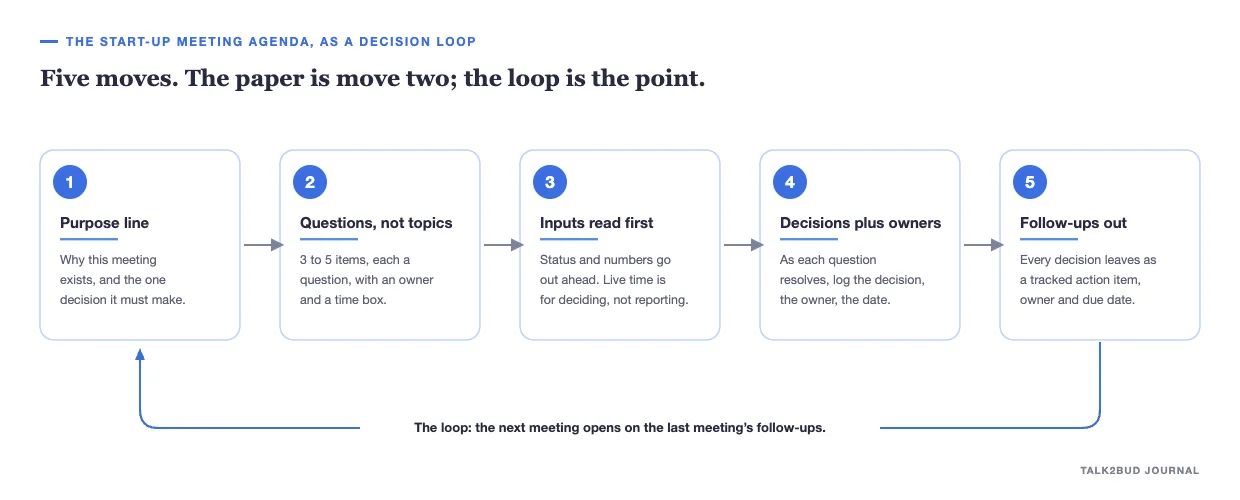
Move one, the purpose line. Write one sentence for why the meeting exists and the single decision it has to produce. If you cannot write that sentence, cancel the meeting and send an email instead. A weekly founder sync whose purpose reads "keep everyone in the loop" is a status broadcast wearing an agenda.
Move two, questions instead of topics. Turn every topic into a question, then give it an owner and a time box. "Runway" is a topic. "Do we cut two hires to hold eighteen months of runway, yes or no," owned by the CEO and boxed to ten minutes, is a decision. Three to five questions is the ceiling for a sixty-minute meeting. The wording is the actual work, because a question tells you who to invite and how you will know the meeting is finished.
Move three, inputs read first. Send the numbers and the status the day before, never live. Startup board guides push a hard version of this rule: send the deck forty-eight hours ahead, and spend most of the live time on the future rather than the past (Value Add VC). The split people quote is roughly eighty percent on decisions and twenty percent on reporting. Reading is faster than listening, and it lets the quiet people arrive with a view.
Move four, decisions with owners. As each question resolves, write the decision, the owner, and the date while the meeting is still happening. A decision that lives only in six people's memories becomes four different decisions by Thursday.
Move five, follow-ups out. Every decision leaves the room as a tracked action item with an owner and a due date. Then the loop closes: the next meeting opens by checking those items, not by asking where everyone left off. Opening on last week's follow-ups is the single habit that turns a recurring meeting from a treadmill into a line that moves.
The loop only holds if someone checks, at the end of each meeting, whether the conversation matched moves one through five. A later section shows how to make that check automatic instead of a chore.
A Worked Example: The Monday Founder Sync
The meeting below is illustrative, a composite rather than a real company. Picture a six-person startup four weeks out from a fundraise. The Monday sync is booked for thirty minutes, and its purpose line reads: decide the three things that unblock this week's fundraise prep.
The pre-read went out Sunday night: the metrics dashboard, last week's action items, and a one-paragraph note from whoever is running diligence. Nobody presents any of it live. The agenda is three questions.
- Do we send the deck to the three warm investors now, or wait for the September numbers? (Owner: CEO. Box: 8 minutes.)
- Given engineering has room for exactly one thing, which feature ships before the partner meeting? (Owner: CTO. Box: 10 minutes.)
- Do we approve the data-room contractor budget, yes or no? (Owner: COO. Box: 5 minutes.)
That leaves seven minutes of slack, which is the point, not waste. By minute twenty-eight the shared doc reads like this:
- Decision: send the deck to two of the three investors now, hold the third for September. Owner: CEO. Due: Tuesday.
- Decision: ship the CSV export, not the dashboard redesign. Owner: CTO. Due: Friday.
- Decision: approve the contractor at the lower bid. Owner: COO. Due: Wednesday.
The meeting did not cover office snacks, the new logo, or three other things someone wanted to raise. None of those were on the agenda, so they went to the async channel where they belonged. The following Monday, the sync opens by reading those three lines aloud and asking whether each one happened. The unfinished ones become that week's first agenda item. That is the loop doing its job.
How It Compares To A Kickoff, A Standup, And A Board Meeting
The decision loop is one shape, and it has close relatives that look similar and fail differently. Read down the column that matches the meeting in front of you.
| Meeting | What it exists to do | Cadence | The trap it falls into |
|---|---|---|---|
| Start-up team meeting | Reach the few decisions that unblock the week | Weekly | Turning into a status broadcast |
| Project kickoff | Align a new project on goals, scope, roles, and risks | Once, at the start | Skipping the risks to feel positive |
| Daily standup | Surface blockers fast, on your feet | Daily, 10 to 15 minutes | Becoming a status report nobody acts on |
| Board meeting | Get real input on one or two strategic bets | Monthly or quarterly, 60 to 90 minutes | Spending the hour reporting, not deciding |
A kickoff is the recurring meeting's cousin, held once at the birth of a project, where the questions are about scope and ownership instead of this week's decisions (Atlassian's kickoff play). A standup is the same loop stripped to blockers and kept short enough to hold standing. A board meeting is the loop scaled up and slowed down, which is why board guides obsess over the same decisions-with-owners discipline. If you want the fill-in-the-blanks versions, our meeting agenda templates cover each one; this page is about the structure underneath them.
Where The Decision Loop Breaks
No framework survives contact with every meeting, and this one has three honest failure modes. The research names them too.
An agenda on its own does nothing. This is the uncomfortable finding under the whole topic: work summarized by meeting scientists shows that simply having an agenda does not, by itself, make a meeting better (strategy+business, cited above). Ownership and follow-through are the active ingredients. A beautifully formatted agenda that nobody follows is decoration with a timestamp.
A rigid agenda can crush the conversation you actually needed. Rogelberg's research notes that the hoped-for creative spark in problem-solving meetings fails to show up most of the time, and marching through a numbered list can make that worse by killing the tangent that was the real reason to meet. A meeting whose job is to think together wants a question and a whiteboard, not a script.
Over-stuffing kills the decisions it promises. Five questions in thirty minutes is a countdown, not an agenda. When the list cannot breathe, the team rushes every decision and reopens all of them next week, which is the exact opposite of a loop. The fixes are unglamorous: fewer questions, real owners, and a genuine check that the meeting followed the plan. That last one is where most teams quietly give up, because checking by memory is tedious.
Using talk2bud To Measure The Meeting Against Its Agenda
The loop has one weak link, and it is the check. At the end of a meeting, few teams can honestly say which agenda questions got answered and which got an owner. Doing that by memory is how the habit dies. This is how to make the check part of the meeting instead of homework.
- Record the meeting where it happens. talk2bud captures the call from your Mac's system audio, with no bot joining the room and nothing announcing itself to the other side. The recording starts on your machine, and the consent flow is explicit rather than a silent participant in the corner. talk2bud runs on Apple Silicon Macs, in English, and is built to capture the conversation, not to replace your project tracker.
- Turn the raw call into a read against the agenda. In talk2bud you pick a Lens, a small analysis playbook for a meeting type, or build your own. Here the Lens is written to measure the call against the agenda: which questions got answered, which got skipped, and what decisions and action items came out, each with an owner named.
- Get the read when the call ends. At the end of the meeting, talk2bud evaluates the transcript against that Lens and hands back the coverage, the gaps, and the decisions-with-owners list. That is move four and move five done for you, and it is the evidence that the meeting followed moves one through three.
- Open next week on it. Those action items become the first agenda item of the next meeting, and the read from this Monday is what you check on the following one. The loop closes on notes you did not have to type.
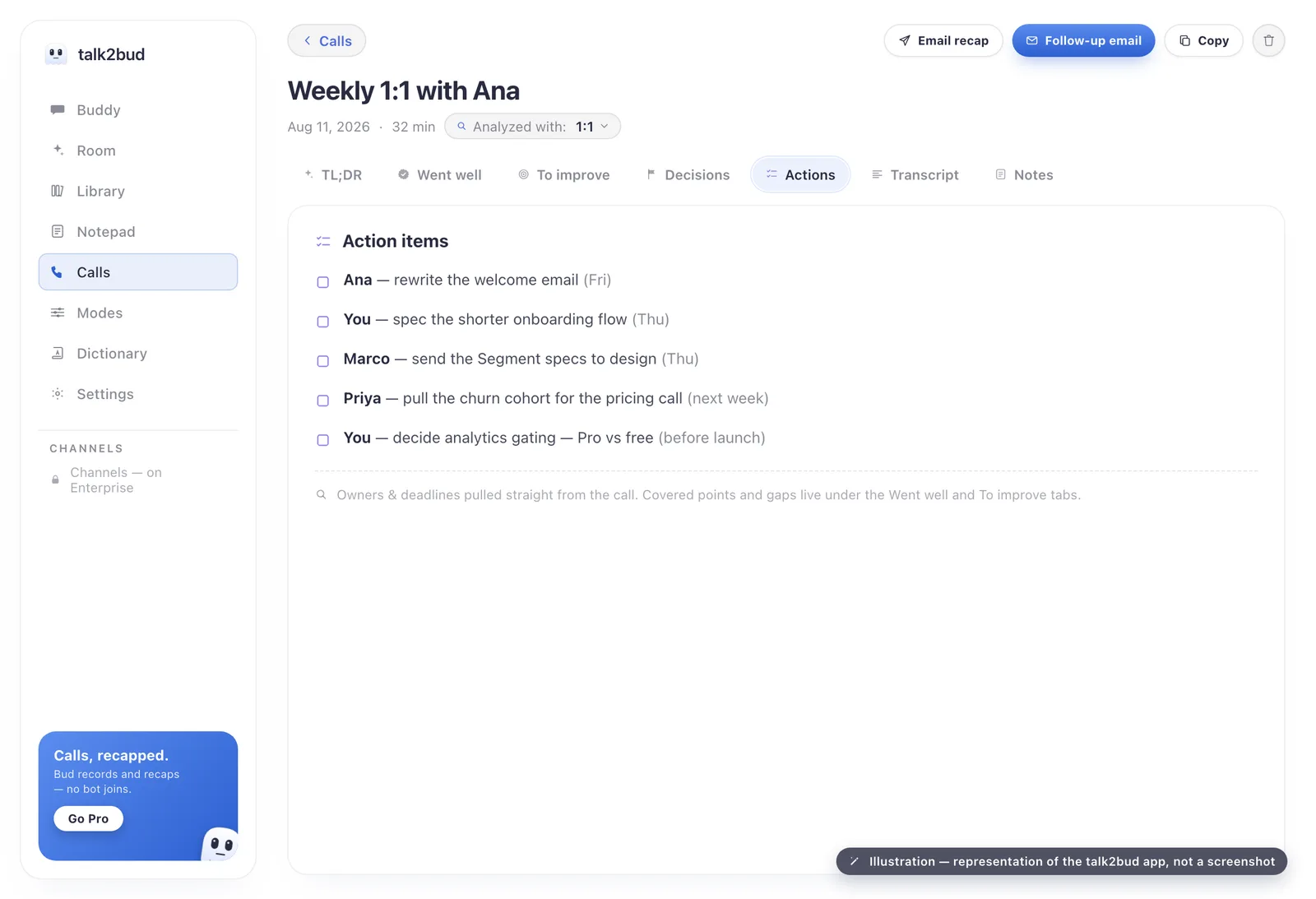
Illustration of the talk2bud app, not a screenshot: a meeting read against its Lens, with owners and deadlines pulled from the call.
For a 1:1, the same read stays between the two people in the conversation and never lands in a shared channel by default, because the analysis of a 1:1 belongs to the two people who were in it.
Frequently Asked Questions
What should be included in a start-up meeting agenda?
A start-up meeting agenda should include a one-sentence purpose, three to five items written as questions to decide rather than topics to discuss, an owner and a time box for each, and a place to record decisions and follow-ups as they happen. Startup guides also recommend sending status and numbers ahead of time so the live meeting spends most of its minutes deciding, not reporting (verified August 2026). Keep the list short enough that every question gets a real answer.
How long should a start-up meeting be?
A recurring start-up team meeting works best at thirty to sixty minutes, and a daily standup at ten to fifteen. Startup board meetings run sixty to ninety minutes, split roughly into five minutes of CEO update, twenty of metrics, thirty on one or two strategic decisions, and ten on action items (Value Add VC, verified August 2026). If the agenda can be answered in less time than you booked, shorten the meeting rather than fill it.
Do meeting agendas actually make meetings more effective?
Not on their own. Research summarized by meeting scientists found that having an agenda, by itself, does little to improve a meeting, and a 2003 study of 187 large companies found half ran static or ad-hoc agendas with no benefit (strategy+business, verified August 2026). What helps is writing items as questions, giving each an owner, and following up on decisions. A start-up meeting agenda is only as good as the meeting's willingness to follow it.
What is the difference between a start-up meeting and a kickoff meeting?
A start-up team meeting is a recurring meeting that reaches the week's decisions, held on a weekly or similar cadence. A kickoff meeting happens once, at the beginning of a project, to align everyone on goals, scope, roles, and risks (Atlassian, verified August 2026). The recurring start-up meeting keeps a project moving; the kickoff starts it. Many teams run a kickoff first and a weekly start-up meeting after.
How do you make sure meeting decisions actually get followed up?
Capture each decision during the meeting with a named owner and a due date, then review those action items at the top of the following meeting. Tools like talk2bud can record the call from a Mac's system audio without a bot and evaluate the transcript against a Lens, returning the decisions and action items with owners at the end of the call. No bot in the call is not a license to skip telling the room, so the honest step is still to announce the recording before you start. The habit that matters most is opening every meeting by checking the last meeting's follow-ups.
When To Skip The Agenda, And What To Use Instead
A decision-loop agenda is the right tool for a recurring meeting that has to produce decisions. It is the wrong tool for at least three others. A daily standup does not need it, because three prompts (what moved, what is blocked, what you need) beat a formal agenda that stretches a ten-minute huddle into a status meeting. A genuine brainstorm should not carry a rigid list at all, since the tangent is the point; give it one question and a whiteboard. An emergency, the outage or the deal falling apart, runs on a shared doc and a timer, not on an agenda nobody had time to build.
For the meetings that do need it, the recurring ones that keep drifting into status theater, the next step is small. Before your next team meeting, rewrite the agenda as three to five questions, give each an owner and a time box, and record the call so you can check, at the end, whether the meeting actually followed it. Run that one meeting through a Lens and look at the gap. If the read shows you covered two of five questions and named zero owners, the agenda was never the problem, and now you can finally see it.
Verified August 2026 against Harvard Business Review, strategy+business, Atlassian, and startup board guides linked above. If you want the call captured cleanly for that check, here is how talk2bud records a meeting from your Mac without a bot in the room, on a consent step you announce out loud rather than a recording that hides.