The Client-Meeting Scoring Rubric (And What Good Sounds Like)
A behavioral 1-to-5 rubric for client meetings, with an annotated excerpt and a scope-creep tripwire that catches the extra ask in the room.
The Client-Meeting Scoring Rubric (And What Good Sounds Like)
A client meeting rarely loses money on the contract you signed. It loses money on the sentence nobody wrote down. In Ignition's 2025 Agency Pricing and Cash Flow Report, 78% of agencies said they rarely or only sometimes bill for out-of-scope work, and 57% quietly lose between $1,000 and $5,000 a month to it (surveyed May 2025, 273 agency leads).
Here is the part that reorders how you should judge a call. The meeting that felt great, the one where everyone left warm and aligned, is usually the meeting where you said yes to everything. "Great" and "gave work away" sound identical in the moment. So a good client meeting is not the friendly one. It is the one where every new ask got named, priced, and written down before anyone hung up, and that is something you can grade from the words on the call.
This piece scores a client meeting the way a discovery call gets scored: six criteria, each with what a weak answer sounds like against what a strong one sounds like, so two people reviewing the same call land on the same number. It is also how talk2bud reads a client call. The app captures the conversation from your Mac's system audio, with no bot joining the meeting, and reads the transcript against a consulting Lens that returns the six scores and flags every scope moment from what was actually said. No bot in the room is a capture choice, not a license to record in secret: you still tell the client you are recording, which is the honest version and the one the app keeps explicit. The rubric below and that Lens are the same object.
Everything here was verified in August 2026 against the sources linked inline: Ignition's 2025 agency survey, PMI's Pulse of the Profession, and two consulting practitioners who write about scope for a living.
The One-Page Play
The method fits on an index card. Open your last client meeting. Give each of the six criteria a 1 to 5 based only on what was said, and write the quote that earned the score. The two lowest criteria are your next meeting's homework. Any criterion that scores a 3 while hiding a new client ask is money you are about to hand over for free.
The scope tally is the number to watch. Count the new or widened requests the client raised, then count how many you named as a change, put a price on, and got a decision about on the call. A meeting can average 4.2 and still be a bad meeting if three asks came up and zero got scoped. The full playbook, with anchors for all five score bands and a 30-day rollout, is in the download section below, as a PDF and an importable Lens.
The Client-Meeting Rubric
A checklist asks "did you discuss scope?" and a consultant who said the word scope ticks the box. A rubric asks what a 2 sounds like against what a 5 sounds like, with the phrasing attached, so the score survives a second reviewer. That is the only property that makes it worth running twice.
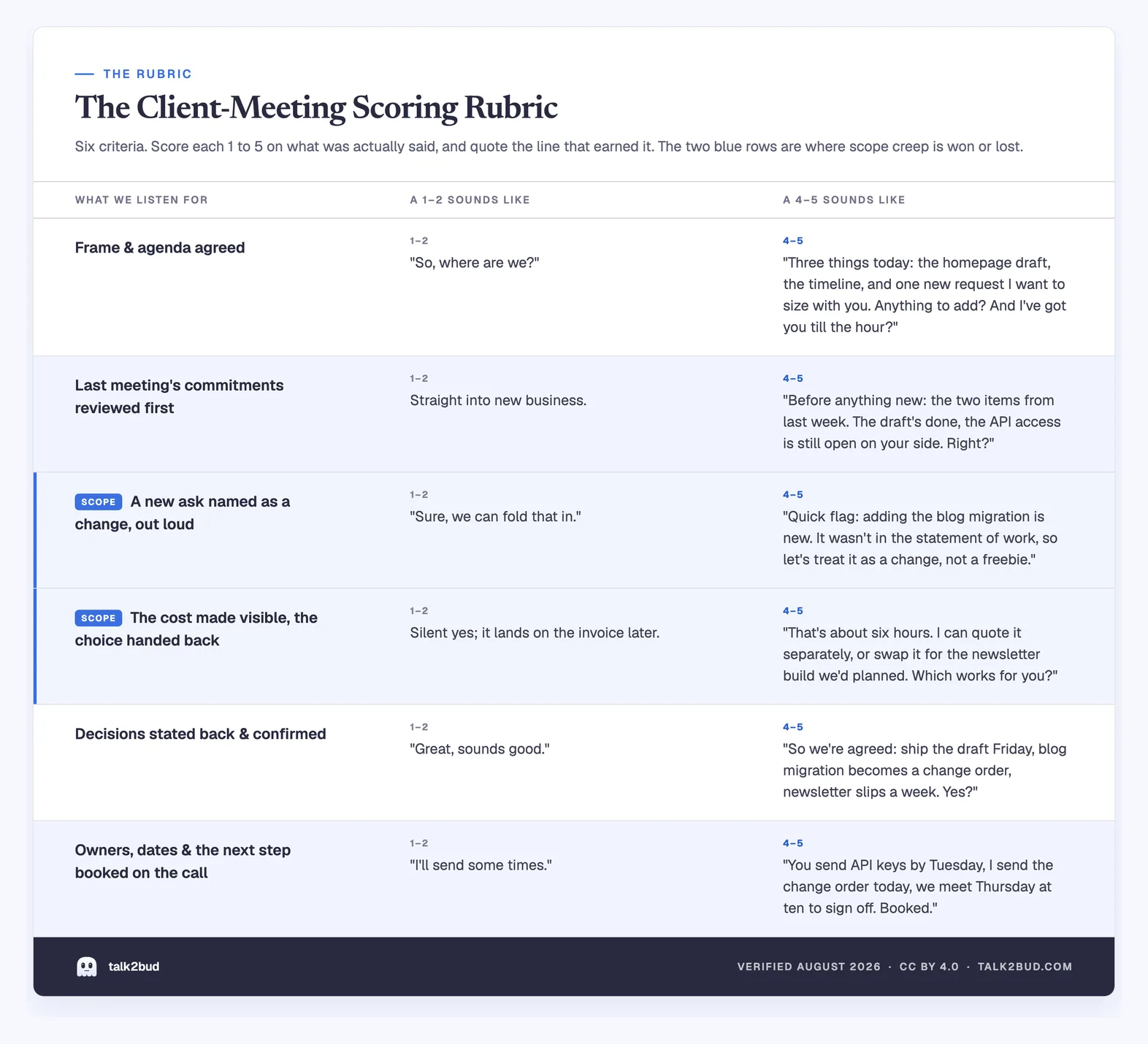
Here is the full rubric, in a form you can copy into your own notes. Score each row 1 to 5, and quote the line that earned it.
| Criterion | Listen for | A 1-2 sounds like | A 4-5 sounds like |
|---|---|---|---|
| 1. Frame and agenda agreed | You state what the call is for, ask what is missing, confirm the time | "So, where are we?" | "Three things today: the draft, the timeline, and one new request I want to size with you. Anything to add? And I have you till the hour?" |
| 2. Last meeting's commitments reviewed first | You open on the open items by owner and status before new business | Straight into new business | "Before anything new: the two items from last week. The draft is done; the API access is still open on your side. Right?" |
| 3. A new ask named as a change, out loud | When the client adds work, you flag it against the agreement instead of absorbing it | "Sure, we can fold that in." | "Quick flag: the blog migration is new, it wasn't in the statement of work, so let's treat it as a change, not a freebie." |
| 4. The cost made visible, the choice handed back | You say what it costs and give the client a real choice | Silent yes; it lands on the invoice later | "That's about six hours. I can quote it separately, or swap it for the newsletter build we'd planned. Which works for you?" |
| 5. Decisions stated back and confirmed | Each decision restated in plain terms and agreed out loud | "Great, sounds good." | "So we're agreed: ship the draft Friday, the migration becomes a change order, the newsletter slips a week. Yes?" |
| 6. Owners, dates, and the next step on the call | Every action gets a named owner and a date; the next meeting is booked | "I'll send some times." | "You send the keys by Tuesday, I send the change order today, we meet Thursday at ten to sign off. Booked." |
Rows 3 and 4 are the two that pay the rent. They are the scope criteria, and they are the reason a client-meeting rubric is different from a generic meeting-quality checklist. Most guidance treats scope creep as a paperwork problem you solve after the fact with a change-request form. It is not. It starts as a spoken sentence in a friendly call, and whether you caught it is audible.
How Scope Creep Actually Sounds
Scope creep does not arrive as a formal request. It arrives as a sidebar. The consulting practitioners at Kiaro put it plainly in July 2026: the dangerous ask comes through "meeting sidebars" and "while you're at it" lines, and "silence is what leads to scope creep in the first place." The tool that catches it is not a contract clause. It is a sentence you say back within the next minute.
Below is a short excerpt from a client status call. It is an illustrative example built to show the scoring, not a real transcript, and it is dated the way a real review would be: a status call from 12 August 2026. The margin notes are what the rubric writes.
Client: The homepage draft looks good. Really happy with it. You: Glad it landed. So we ship it Friday as planned. Client: Perfect. Oh, and while you're in there, could you also migrate the old blog over? Would save us a headache. You: Sure, I can probably take a look at that too.
Criterion 3, score 2. The migration is a new deliverable and it went by unnamed. "I can probably take a look" is a reflex yes with a hesitation attached, which is worse than a clean yes because it commits you without scoping anything. The line that would have earned a 5 is one sentence: "Quick flag, the migration wasn't in our scope, so let me size it and come back with a number." Criterion 4, score 1. No cost was spoken, so the six hours the migration takes will surface on a timesheet the client never approved.
Now the same moment, run well.
Client: Same question, but could you also migrate the old blog while you're in there? You: Happy to. That one's outside our current scope, though, so let me price it rather than fold it in quietly. It runs about six hours. Two options: I invoice it on its own, or it takes the newsletter build's slot this sprint. Your call. Client: Take the newsletter's slot. The migration matters more right now.
Criterion 3, score 5. The ask is named as out-of-scope in the moment, without a flinch. Criterion 4, score 5. A cost and a real choice, and the decision goes back to the client, which is exactly the move David A. Fields describes in his consulting scope playbook: you never refuse, you attach the price and let the client structure it. Same request, same warmth, a five-hundred-dollar difference in what you get paid.
Calibration: Two Reviewers, One Number
A rubric is only worth running if two people reading the same call land within a point of each other. When they do not, the disagreement is almost always about an adjective, not a fact. Calibration fixes that by arguing to the quote.
Try it. Score criterion 6 on this closing exchange, then read the key.
You: This was great, really productive. I'll pull together some notes and next steps and get them over to you. Client: Sounds good, talk soon.
Score it before reading on. The answer is a 2. A reviewer who liked the meeting wants to give it a 4, because it felt organized and the consultant promised notes. But criterion 6 is not "did you intend to follow up." It is "did an owner, a date, and a next step get set on the call." Nobody named a date, nobody booked the next meeting, and "some notes and next steps" is a promise, not an assignment. The number lives in what was said, not in how the call felt. That single discipline, scoring the words and not the vibe, is what makes two reviewers agree, and it is the same reason a Lens and a human land on the same score: both are reading the transcript, not remembering the mood.
The rule that keeps calibration honest is the quote rule. No score without a line from the call attached. A 2 you cannot quote is a 2 you are inventing, and the moment you argue about the quote instead of the impression, the disagreement resolves itself.
How the Rubric Changes by Engagement
The six criteria hold across client work, but the weights move.
On a retainer, criterion 2 carries the most risk. A monthly relationship dies by a hundred small unreviewed asks, so opening every meeting on last cycle's commitments is the habit that keeps the retainer from becoming an all-you-can-eat buffer. On a fixed-scope project, criteria 3 and 4 dominate, because every unscoped ask eats a fixed fee that cannot grow. At a kickoff, criterion 1 is nearly the whole score: the frame you set on day one is the boundary you will defend for six months, and a kickoff that never states what is out of scope has already lost the argument.
Seniority changes who is expected to run each criterion. A junior consultant is scored hardest on criteria 5 and 6, the mechanics of confirming and assigning, because those are learnable and non-negotiable. A partner or account lead is scored hardest on 3 and 4, because naming a change and pricing it in front of a client is the judgment that seniority is supposed to buy. If your most senior people score low on scope, the problem is not training. It is that nobody made scope their job.
The Four Ways Reviewers Score This Wrong
A rubric removes most bias, but four failure modes survive if you let them.
Recency. You remember the last two minutes and score the whole call on the goodbye. A warm sign-off inflates a meeting that decided nothing. Fix it by scoring criterion by criterion, in order, before forming an overall impression.
Halo. The client was delighted, so every criterion drifts upward. Delight is not a score. A meeting can end with a thrilled client and a 1 on scope, and that combination is the single most expensive outcome in the Ignition survey, because a happy client who was never quoted still expects the work for free.
Severity and leniency. Two reviewers who run hot and cold produce scores that cannot be compared. This is exactly what the anchor text is for: when a score has to point to the sentence that a 2 or a 5 sounds like, personal strictness stops mattering. The consistency problem here is the same one PMI traced across the industry: uncontrolled change is not an event, it is a measurement failure that compounds.
Rolling It Out in 30 Days
Week one is a pilot. Score your own last five client meetings without changing how you run them, just to get a baseline and find your weakest criterion. In week two, calibrate: have a colleague score two of the same calls, and anywhere you disagree by more than a point, argue it to the quote until the anchor settles it. By week three, every live client meeting goes through the rubric, and you report the scope tally to yourself each Friday, asks raised against asks scoped. The final week is for reading the trend rather than the averages. If criteria 3 or 4 stay low with one specific client, the fix is not coaching, it is reopening the statement of work.
Opening each meeting on last week's follow-ups is the habit that does the quiet work here, the same loop that turns a recurring meeting agenda from a treadmill into a line that moves. The rubric just gives that loop a number.
Running the Rubric on the Call You Just Had
You will not score meetings by hand forever, and the point of the rubric is to run on every call without adding an hour of admin to a week that is already behind. Here is the path from a live client call to a score.
1. Capture the call without a bot in the room. talk2bud records from your Mac's system audio, so nothing joins the meeting as a participant and no bot shows up in the attendee list. That is a capture choice, not a secrecy one. No hidden bot is not the same as recording in secret, so you still tell the room you are capturing the call and keep the consent the app treats as explicit. On a client call, the honest line is short: "I'm recording this so nothing slips, that alright with you?" How the system-audio capture works, and why it beats a screen recorder that loses the other side's voice, is worth a read on its own.
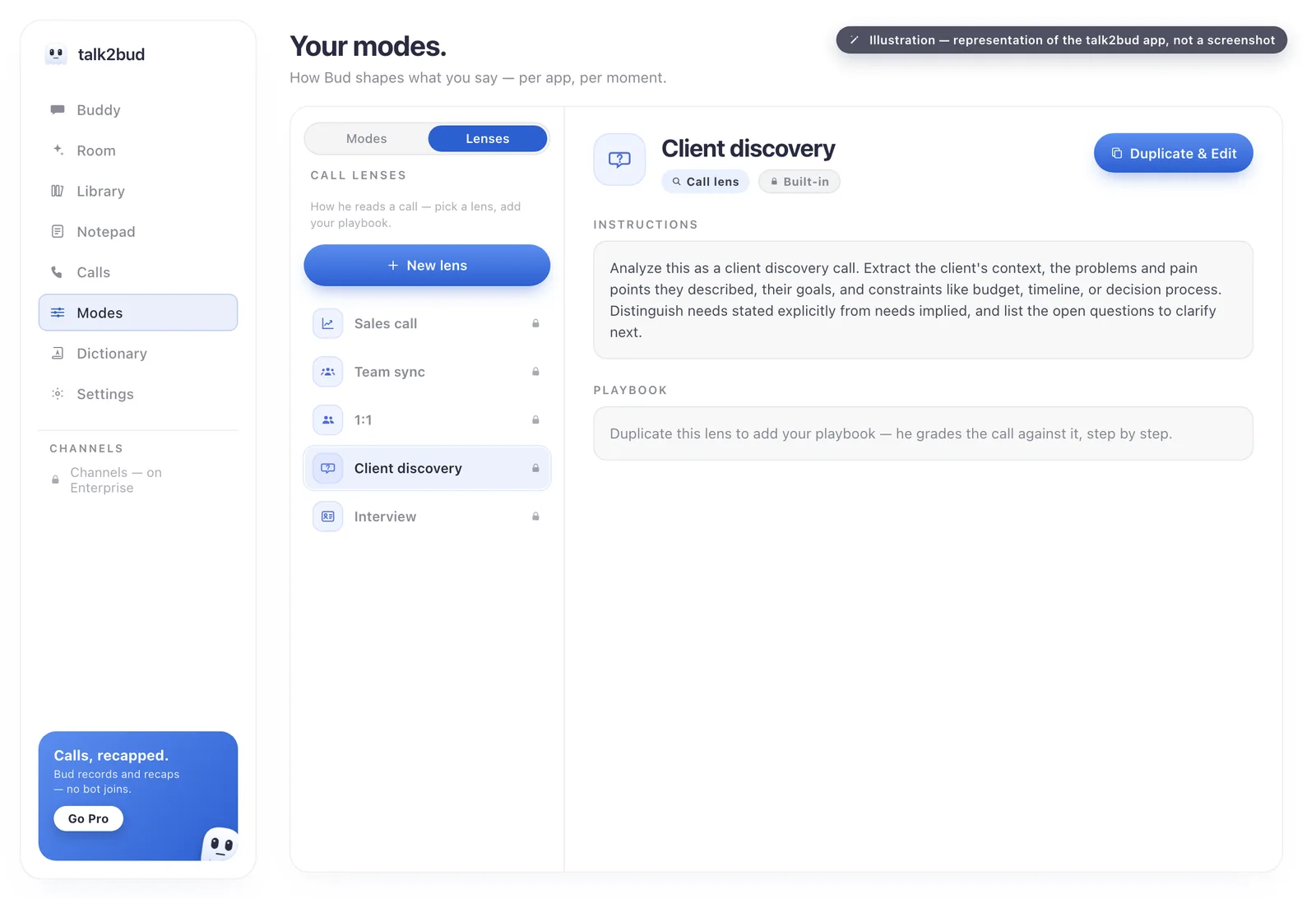
2. Pick the consulting Lens. In Modes, switch to Lenses and choose Client discovery, or duplicate it and paste in the client-meeting rubric from this page as its playbook. The Lens is the rubric: the same six criteria, the same quote rule.
3. Read the score, not the recording. When the call ends, talk2bud scores the transcript against the Lens and hands back the six criteria with the quote that earned each, plus every scope moment flagged: the sentence where the client added work, and whether you named it, priced it, and closed it. You read a page, not a forty-minute recording. The next meeting's job is whatever scored lowest.
That last part is the whole reason to run it on the machine instead of in your head. A human reviewer forgets the "while you're in there" line by the time the call is over. A Lens reading the transcript does not, and it quotes it back to you before the invoice does.
Download the Client-Meeting Playbook
The full playbook is free, under a CC BY 4.0 licence, so you can adapt it and re-share it with attribution.
- The Client-Meeting Playbook (PDF, 8 pages). The thesis, all six criteria with anchors for every score band, the annotated excerpts, the calibration exercise, and the 30-day rollout. Download the PDF.
- The importable Lens (Markdown). The same six criteria as a file talk2bud imports as a call Lens. In the app, go to Modes, then Lenses, then New, and import it. Download the Lens file.
There is no email gate. The playbook and the Lens are byte-for-byte the same criteria, so the score you give a call by hand and the score the app gives it come from the same rubric.
Frequently Asked Questions
What is scope creep in consulting?
Scope creep in consulting is the uncontrolled expansion of a project beyond what was agreed, usually through small unbilled additions rather than one big change. It typically enters through informal client requests in meetings ("while you're at it, could you also...") that get absorbed without being named, priced, or logged. In Ignition's 2025 agency survey of 273 leads, 57% of agencies lose between $1,000 and $5,000 a month to work they never invoice.
How do you prevent scope creep with clients?
You prevent scope creep with clients by catching the new ask in the meeting where it is raised, not in a change-request form filed later. Name it as out-of-scope out loud, state what it costs in hours or fee, and hand the decision back to the client with a real choice, such as billing it separately or swapping it for planned work. talk2bud supports this by scoring each client call against a consulting Lens and flagging every scope moment from the transcript, so nothing slips through unnamed.
How do you say no to a client without losing them?
You rarely need a flat no. The move consultants use is "yes, and here is what it costs": you agree in principle, make the trade-off visible, and let the client choose how to structure it. Consultant David A. Fields frames the graceful version as "yes, we can absolutely do that, and we'll need to expand our relationship a bit," which reframes an addition as a decision rather than a favor. The client keeps their agency, and you keep getting paid.
What should a client meeting cover?
A client meeting should cover four things in order: last meeting's open commitments with owners and status, the substantive agenda items for today, any new or changed requests named and scoped, and a close that restates the decisions and books the next step with a date. A meeting that skips the review of prior commitments or ends on "I'll send some times" has left its two most valuable moments on the table.
What causes scope creep?
Scope creep is caused by unclear boundaries at the start and unnamed additions along the way. A vague statement of work makes it easy for new tasks to slip in, and each informal client request that gets absorbed without a change process widens the project a little more. PMI's Pulse of the Profession found 52% of projects experienced scope creep, up from 43% five years earlier, and long or loosely scoped engagements are the most exposed because they create more chances for the unnamed ask.
Verified August 2026 against Ignition's 2025 Agency Pricing and Cash Flow Report (published May 2025, n=273), PMI's Pulse of the Profession 2018, and published scope-management guidance from David A. Fields and Kiaro. Figures are quoted from those sources; the transcript excerpts are illustrative examples written to show the scoring, not real client calls.