Is It Illegal to Record Conversations? The Plain-English Legal Guide
The law rarely bans recording a conversation you are in. It bans doing it in secret. Here is the rule by state, with the statute linked, and consent scripts you can copy.
Is It Illegal to Record Conversations? The Plain-English Legal Guide
Short answer: In most of the United States, recording a conversation you are part of is legal, because federal law and 38 states follow one-party consent. About a dozen states require every person to agree first. The line that decides your risk is almost never "did you record?" It is "did you do it in secret?" Disclose the recording, get a yes, and you are on the safe side of nearly every statute in the country.
That distinction is the whole guide. Wiretapping and eavesdropping laws were written to punish the hidden microphone, not the honest one. So the durable way to record your own calls, in any state, without a lawyer on retainer, is to build consent into the moment instead of hoping the state you are in forgives silence. Lawyers call it consent. It is cheaper to think of it as design: pick the habit, and the tool, that makes disclosure the default.
This page gives you the federal floor in plain English, a state-by-state table with each statute linked to its source, the four work situations people actually get wrong, and scripts you can paste into a call opener or a calendar invite today.
This is general information, not legal advice. Laws change and vary by jurisdiction, so confirm your situation with a qualified attorney. The "verified" date below is the promise that the statutes here were read on that date.
The Short Version, And The Catch
Two words sort almost every recording question: one-party and all-party.
In a one-party consent state, one person in the conversation has to know and agree, and that person can be you. If you are in the room or on the call, you can record it. Federal law works the same way, which is why the national default is permissive.
In an all-party consent state (often called two-party, though it means everyone), each person has to consent before the recording is lawful. Miss one, and a call you thought was yours becomes a criminal offense in some states and a civil suit in others.
Here is the catch the fear-driven version of this question hides. The all-party statutes almost all turn on secrecy or notice, not on the act of recording. Massachusetts bans recording done "secretly," so a recording you announce is fine even though you are a participant. Washington treats a spoken announcement, recorded at the start, as consent. Montana punishes the "hidden" device. Read them together and a pattern appears: the law is not trying to stop you from keeping a record of your own meeting. It is trying to stop you from doing it to people who do not know. Announce it, and most of the risk evaporates.
How The Law Actually Works: The Federal Floor
Federal recording law lives in the Wiretap Act, part of the Electronic Communications Privacy Act, at 18 U.S.C. § 2511. Subsection (2)(d) is the sentence that matters:
It shall not be unlawful under this chapter for a person not acting under color of law to intercept a wire, oral, or electronic communication where such person is a party to the communication or where one of the parties to the communication has given prior consent to such interception unless such communication is intercepted for the purpose of committing any criminal or tortious act.
Three things fall out of that sentence. First, if you are a party to the conversation, federal law lets you record it. Second, if you are not a party, you still can if one participant consents and knows about it. Third, there is a trapdoor. Recording done to commit a crime or a tort, with blackmail as the classic example, is never protected, even when a party agreed.
Federal law is a floor, not a ceiling. Section 2511 sets the minimum that applies everywhere, and a state is free to demand more. Every all-party state below is a state that decided one-party was not enough. So the working rule is simple: you never get to rely on the federal one-party standard to override a stricter state law where the conversation happens.
One-Party And All-Party States: Read The Row That Matches You
Most of the country tracks the federal rule. The 38 remaining states and the District of Columbia are one-party consent, including the big ones people ask about most, New York and Texas, where recording a call you are on is legal. The table below is the exceptions, the states where a quiet recording can bite, each linked to the statute so you are reading the law and not a summary of it.
| Jurisdiction | Rule | Statute (source) | The detail that bites |
|---|---|---|---|
| Federal (floor) | One-party | 18 U.S.C. § 2511 | You may record a conversation you are in; a criminal or tortious purpose voids the protection. |
| California | All-party | Cal. Penal Code § 632 | Applies to a "confidential communication." Up to $2,500, rising to $10,000 on a repeat. |
| Connecticut | Phone: all-party. In person: one-party | Conn. Gen. Stat. § 52-570d | Phone recording needs written consent, a recorded verbal notice, or a repeating tone. |
| Delaware | Disputed; treat as all-party | 11 Del. C. §§ 2402, 1335 | Two statutes conflict: the wiretap section reads one-party, the privacy section reads all-party. |
| Florida | All-party | Fla. Stat. § 934.03 | Recording without everyone's consent is a third-degree felony. |
| Illinois | All-party (private talks) | 720 ILCS 5/14-2 | Only bites when the recording is surreptitious and the conversation was private. |
| Maryland | All-party | Md. Cts. & Jud. Proc. § 10-402 | Felony, up to five years or a $10,000 fine. |
| Massachusetts | All-party (no secret recording) | Mass. Gen. Laws ch. 272 § 99 | Bans "secret" recording. Announce it and a participant is fine; up to five years if hidden. |
| Montana | All-party (notice) | Mont. Code Ann. § 45-8-213 | A recorded warning cures it; the offense is the hidden device. |
| New Hampshire | All-party | N.H. Rev. Stat. Ann. § 570-A:2 | Recording without all-party consent is a felony; one-party-only recording is a misdemeanor. |
| Oregon | In person: all-party. Phone: one-party | Or. Rev. Stat. § 165.540 | For an in-person talk, every participant must be "specifically informed." |
| Pennsylvania | All-party | 18 Pa. Cons. Stat. § 5704 | Felony under § 5703; the training and quality-control carve-out needs only one-party consent. |
| Washington | All-party (announce and record it) | RCW 9.73.030 | A spoken announcement, itself recorded, counts as consent. |
Three of these states are not clean all-party states, and pretending otherwise is how people get surprised. Connecticut and Oregon split by medium: a phone call and a face-to-face talk follow different rules in the same state. Delaware carries two statutes that point in opposite directions, and the safe reading is all-party. A short list of states, including Nevada, Michigan, and Vermont, have one-party-sounding statutes that courts or common law have pushed toward all-party in practice; if your call touches one of them, get consent and treat it as all-party until you have confirmed your state, because "close enough" is not a standard you want to defend after the fact.
Recording At Work: Four Situations People Actually Get Wrong
The statute tells you whether a recording is legal. It does not tell you whether recording your manager will end your job, or which state's law governs a call that crosses three of them. These are the four cases readers ask about, with the practical move for each. Each carries the same caveat as the rest of the page: it is general information, not legal advice for your specific situation.
The 1:1 with your manager. You are a party to the meeting, so in a one-party state you may record it. In an all-party state you must have your manager's agreement first. Even where the wiretap law says yes, employment rules are a separate question: many companies ban recording by policy, and violating that policy can get you fired even if the recording was legal. The move: if you want a record of a 1:1, say so and ask. A recording you can show a person is worth more than one you have to hide, in a courtroom and in the room.
The multi-state notetaker. You run sales or support calls from one state to customers in twenty. When the parties sit in different states, courts disagree about which law applies, some looking at where the recording device is, others at where the recorded person is. You cannot win that argument in advance, so do not try. The only safe policy for a multi-state operation is to treat every call as all-party: announce the recording at the top, every time, and get a yes. One habit, applied to all calls, and the choice-of-law question never gets to bite.
The interview. Recording a face-to-face interview is generally lawful when the device is in plain view, or any conversation when you state that you are recording and the other person keeps talking. That is disclosed recording, and it is the safe path everywhere, including Massachusetts, where secrecy is the trigger. Put the recorder on the table, say the sentence, and get the yes on the recording itself.
The participant in the EU. The moment someone on the call is in Europe, US one-party consent stops being enough. Under the GDPR you generally need explicit consent or another lawful basis, and here is the part that surprises Americans: staying on the line after a notice does not count as consent in the EU the way it can in the US. For a cross-border call, follow the stricter regime, get an active yes, and keep it. GDPR analysis turns on your specific facts, so confirm your lawful basis with a qualified attorney before you rely on it.
Consent Scripts You Can Copy
Consent sounds heavy until you write it down. It is one sentence, said once, and it turns a legal question into a settled fact. Here are the lines for the four moments you will need them. The full set, plus the wording for a recorded announcement that satisfies states like Washington and Connecticut, is in the free Script Pack below.
The call opener (say it first, before anything else):
"Before we start, I'm recording this call so I can focus on the conversation instead of taking notes. Is that okay with everyone?"
Wait for the yes. On a call in an all-party state, that recorded yes is your consent.
The calendar-invite line (sets expectations before anyone joins):
"Heads up: this meeting will be recorded so we have accurate notes. Let me know in advance if you'd prefer we don't."
The pre-meeting email (for interviews or sensitive calls):
"So you know what to expect, I plan to record our conversation for my notes only. If you're not comfortable with that, we can take notes the old-fashioned way. Just tell me."
The in-person line (when the recorder is on the table):
"I've got this recording so I don't miss anything. Everyone good with that?"
Where Recording Ends And Surveillance Begins
This guide covers recording a conversation you are part of. It does not cover the very different world of recording other people who are not talking to you: a hidden camera in a break room, a manager taping employees they are not speaking with, a device left running in an empty office. That is surveillance, and it runs into a separate stack of laws, workplace privacy rules, and, for employers, labor law. The National Labor Relations Act, for example, protects some employee recording tied to working conditions, and cuts against blanket bans in ways that shift with the current board.
The clean line to hold: a record of a meeting you were in, that everyone present knew about, is a normal business practice. A record of people who did not know you were listening is a legal problem waiting to happen. This page is about the first. If you are anywhere near the second, that is the point to call a lawyer, not to read a blog.
Transparency By Design
Most of the legal risk in this whole guide comes from one thing: a recording that people did not know about. Which is exactly the problem with a meeting notetaker that silently joins the call as a ghost participant. It is a bot in the room that nobody agreed to, and in an all-party state it is the fact pattern the statute was written to punish.
talk2bud was built on the other side of that line. It captures the meeting from your Mac's system audio, so nothing joins the call as an uninvited attendee and no bot announces itself as a stranger in the room. That design has an honest consequence worth stating plainly: no hidden bot is not the same as recording in secret. Capturing quietly from your own machine is only safe when you still tell the room, which is why the app treats the consent step as explicit rather than something to skip. The safest recorder is the one whose default is to disclose, not to hide.
Two more choices matter for the situations above. A 1:1 analysis in talk2bud belongs to the two people in the conversation and does not get posted to a team channel by default, because the person across the table consented to a conversation, not to an audience. And when you announce a recording with one of the scripts above, you are doing on purpose what states like Washington already treat as consent: saying it out loud, on the record.
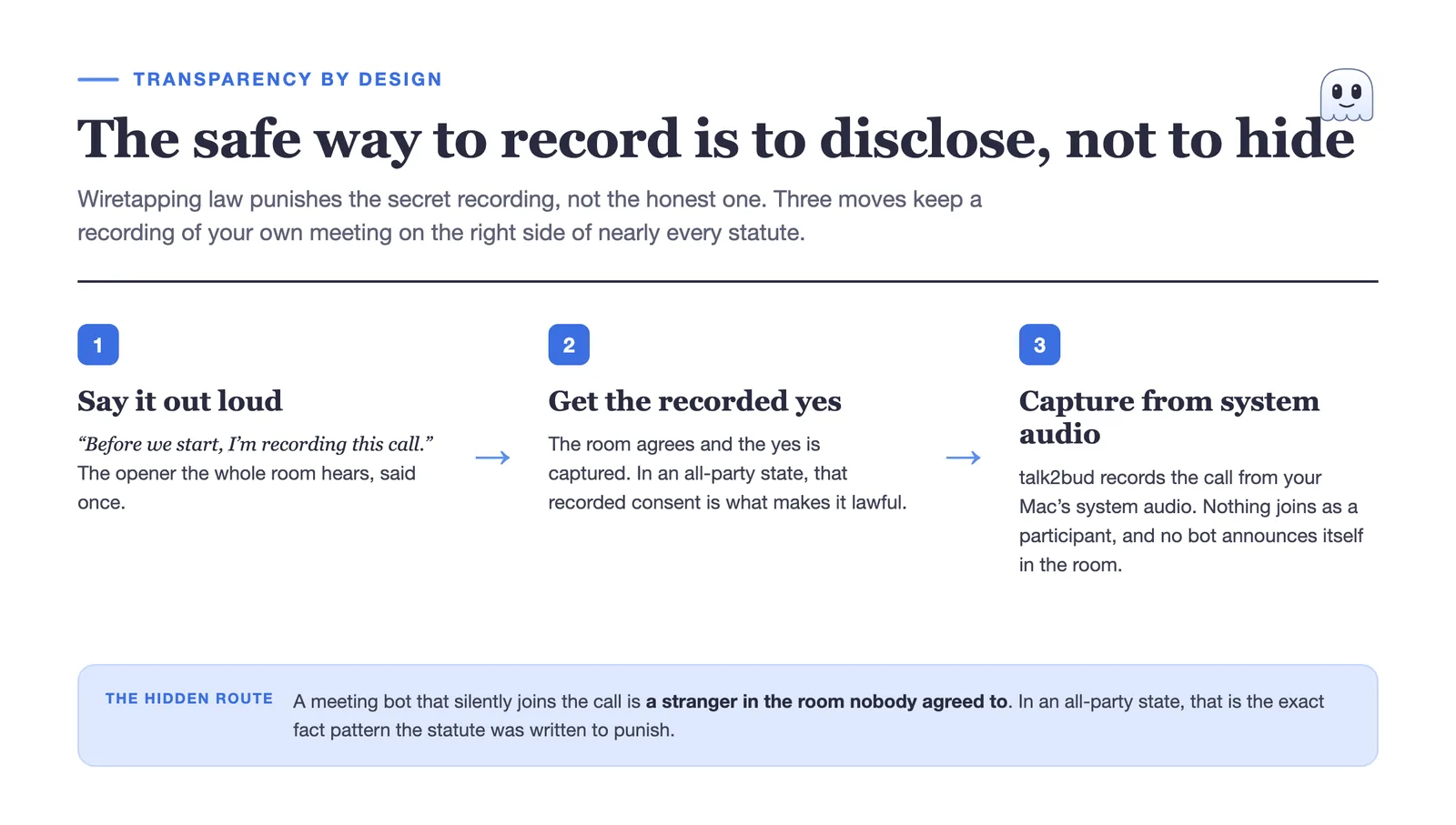
talk2bud is a Mac app (Apple Silicon), in English, and it is made to capture the conversation, not to run a covert wiretap. That focus is the point: a tool that cannot slip into a room unannounced is a tool that keeps you on the right side of the line this whole page is about.
Get The Consent Script Pack
The four scripts above, plus the recorded-announcement wording for all-party states, a one-line version for calendar tools, and a short checklist for a multi-state call, are in a one-page PDF you can keep next to your desk.
- The Recording Consent Script Pack (PDF) · 2 pages · copy-paste consent lines for calls, invites, interviews, and all-party announcements.
Free to use and share under CC BY 4.0. No email required.
FAQ
Is it illegal to record a conversation without consent?
It depends on the state. Under federal law and in the 38 one-party consent states, you may record a conversation you take part in without anyone else's permission. In about a dozen all-party consent states, including California, Florida, Illinois, and Washington, recording without every participant's consent can be a crime or grounds for a lawsuit. Recording for a criminal or tortious purpose is never protected anywhere.
Can you record someone without them knowing?
In a one-party consent state you can record a conversation you are in without telling the other person, because your own knowledge satisfies the law. In an all-party consent state you cannot: everyone must be aware and agree, and secret recording is the specific act those statutes punish. Because interstate and cross-border calls follow the stricter law, the safe practice everywhere is to disclose the recording rather than hide it.
Is it illegal to record a conversation at work?
Recording at work is governed by the same one-party or all-party state rule as any other conversation, so a 1:1 you are part of is often legal to record where you sit. Legality is only half of it: many employers ban recording by policy, and breaking that rule can cost you the job even when the recording itself was lawful. For workplace recordings, check both your state's consent law and your employer's policy before you press record.
What states require two-party consent to record?
The states most consistently treated as all-party (often called two-party) consent are California, Delaware, Florida, Illinois, Maryland, Massachusetts, Montana, New Hampshire, Pennsylvania, and Washington. Connecticut and Oregon require all-party consent for some conversations and one-party for others, depending on whether the call is by phone or in person. A few more states are pushed toward all-party by case law, so confirm your specific state before recording.
Is it illegal to record a phone call?
You may record a phone call you are on without telling the other person under federal law and in the one-party consent states. In all-party consent states you must have every party's consent, and several of those states, such as Washington and Connecticut, let you satisfy it with a recorded announcement at the start of the call. When a call crosses state lines or reaches someone in the EU, follow the strictest law that could apply and get everyone's consent.
The Rule In Three Lines
If you remember nothing else, remember the shape of the risk.
- One-party state, and you are on the call: you can record it. Telling people is still the better habit.
- All-party state, or a call that crosses state lines: announce the recording and get a yes before you keep going.
- Anyone in the EU, or you are unsure: treat it as all-party, get active consent, and keep the record of it.
Every one of those lines is the same move said three ways: disclose. The single next step is to make that move automatic. Keep the Consent Script Pack where you take calls, and the question "is this legal?" stops being one you have to answer under pressure.
For the wider picture, see our guide to meeting-recording consent and privacy, and if your recordings happen on video calls, how to record a Zoom call without a bot in the room walks through the disclosed, no-ghost-participant setup.
This is not legal advice, and it is worth saying plainly one more time. Every rule on this page was written from our own reading of public statutes at their official sources, not from a lawyer's desk. It is general information, it can fall out of date, and it turns on facts this page cannot see. So before you act on any of it, and above all before you record, confirm your own situation with a qualified attorney licensed in your jurisdiction. We would honestly rather you make that call than lean on a blog post when the stakes are real.
Effective date of research: August 2026. Statutes above were read at their official sources on August 11, 2026. Verified August 2026.