Seven Meeting Introductions That Don't Burn the First Five Minutes
A copy-ready opener for seven kinds of meeting, the five beats every good one shares, and the single line that tells the record what to keep.
Seven Meeting Introductions That Don't Burn the First Five Minutes
The best meeting introduction examples are not greetings, they are contracts. In under a minute, a good opener names the one outcome the meeting owes, the decision on the table, and where the notes will land. Everything below is a copy-ready version of that, sorted by the kind of meeting you are about to run.
A weak opener lets a meeting drift before it starts. People arrive unsure what they are deciding, so the first ten minutes go to re-explaining why everyone is in the room. The repair is not charisma. It is a short script that states the terms out loud, plus one beat most openers skip: who is capturing the meeting, and where the decisions go afterward. That last beat is the one that tells the recording what to hold onto, which is where talk2bud comes into a page about openers.
The cost of skipping it is well documented. In a Harvard Business Review survey of 182 senior managers, 71% said meetings are unproductive and inefficient, and 65% said meetings keep them from their own work. A minute spent naming the outcome is the cheapest defense against being one of those meetings.
The Opener, Beat By Beat
Every version further down is this same skeleton with the words changed. Read it aloud once; it takes about forty seconds.
1. Why we're here.        "By the end, we'll have {the one outcome}."
2. The decision, as a Q.  "The call is: {yes or no}?"
3. Who's here, and why.   "{Name} owns {area}. {Name} decides {thing}."
   (only with new faces)
4. How we'll use the time. "{N} minutes, {N} items. Questions go {in chat}."
5. Where this lands.       "{Name} is capturing. Decisions go to {place}."
Beat 1 is the whole meeting in a sentence, and it is the one people skip because it feels obvious. It is not obvious to the person who was double-booked and joined thinking this was the other call. Beat 2 turns a topic into a question, so anyone can tell later whether the room answered it. Beat 3 exists only when there are faces the group has not seen, and the useful version is not a job title, it is the one thing that person owns or decides here. Lucid Meetings' guide to leading introductions lands on the same shape: the name, the role, and why they are in the room.
Beat 4 sets the shape so nobody has to guess when to jump in. Beat 5 is the one almost no opener includes, and it is what this page is built around: name who holds the record, and where it goes, before anyone starts talking. You may know the popular openers already, like the IEEI framing from Leadership Strategies (Inform, Excite, Empower, Involve), or the 3P method (Purpose, Preparation, Presentation). Both are good at the front half, the why. Neither says where the record lands.
Copy-Ready Meeting Introduction Examples, One Per Meeting Type
Each opener is written the way you would actually say it, with example names. Swap the names, the numbers, and the place the notes go; the beats stay put. None of these are real people or companies.
The weekly team sync
A recurring sync earns its slot by ending with every blocker owned, so beat 1 does the work and beat 5 keeps it from evaporating.
"Fifteen minutes, same as always. By the end, every blocker has a
name next to it. Round the room: what moved, what's stuck, what you
need. Priya's on notes, and anything we decide goes in the team doc."
The version that fails opens with "so, updates?" and lets the sync become a status crawl. Rogelberg's research on meetings is blunt about it: a leader who opens with a purpose runs a different meeting than one who opens with a to-do list.
The project kickoff
New faces, unsettled scope, no history in the room. Beat 3 is where this one is won.
"Thanks for making time. By the end we'll agree three things: the
scope for phase one, who owns each workstream, and the date of the
first milestone. Quick round first, name and the one piece you own,
since half of us haven't worked together. Notes go in the project
doc, and I'm recording the call."
Kickoffs run long when nobody states the outcome, so the room relitigates scope for forty minutes. Beat 1 caps that by naming what agreement looks like.
The client or discovery call
External, both sides new to each other, and the whole thing hinges on a next step.
"Thanks for the time. What I want out of the next thirty minutes is a
clear picture of how you handle billing today, and whether it's worth
changing now. I'll send a short recap after with anything we agree to.
I've got a notetaker running on my side, so flag me if anything
shouldn't be captured."
An external call lives or dies on the next step, so beat 1 points straight at it. The consent line is not filler: capturing the call is honest only when the other side knows, which is why it belongs in the opener and not after.
The one-on-one
"Your time first, so what's on your list? We'll leave with two or
three things we've both committed to. And this one stays between us,
it doesn't go to the team channel."
A 1:1 that opens with the manager's status questions is a status meeting wearing a 1:1's name. Leading with the report's agenda is the whole difference, and the privacy line matters because a 1:1 belongs to the two people in it.
The decision meeting
"One decision today: do we ship the new tiers on the first, or hold a
week for the billing fix? Dana makes the final call; the rest of us
give input. Fifteen minutes on risk, ten on cost, five to decide.
Sam's capturing, and the decision lands in the pricing thread."
Most "decision" meetings never state the decision as a yes or no, so they end on a vague "let's circle back." Beat 2 forces the question into the open, and naming who decides stops the room from mistaking discussion for a vote.
The board or stakeholder review
"Three items need a vote, four are for awareness. I'll flag which is
which as we go. Rebecca's keeping the minutes, and approvals get
recorded against each motion."
A board opener's job is to separate what needs a decision from what is background, so directors don't debate the weather. Here beat 5 is a governance requirement, not a courtesy: the minutes are the record that counts.
The all-hands or town hall
"One message today, then fifteen minutes for your questions. Drop them
in the thread as they come. We're recording, so anyone who missed it
can watch, and any question we don't reach gets a written answer by
Friday."
A town hall fails when leadership talks for fifty-five minutes and takes questions in the last five. Naming the Q&A window up front, and promising the unanswered ones in writing, is what gets people to actually ask.
Reading the Room Before You Pick One
If you have one second to decide which beats to lead with, use this.
| The meeting owes | Lead with | Never skip |
|---|---|---|
| Alignment (sync, standup) | Beat 1, the outcome | Beat 5, where it lands |
| A shared plan (kickoff) | Beats 1 and 3 | Beat 3, who owns what |
| One decision | Beat 2, as a question | Beat 2 |
| A next step (client) | Beat 1, then the recap | The consent line |
| A person's growth (1:1) | Their agenda first | "This stays between us" |
| Information (town hall) | The one message | The Q&A window |
One Opener, Slowed Down
Here is a single opener with its beats labeled, so the pattern is visible. The team and the meeting are invented for this page.
[1] "By the end, we'll have picked one launch date everyone can staff.
[2]  The call is: can we hit October 6, yes or no?
[4]  Twenty minutes. Engineering first on risk, then marketing on the
     campaign, five to lock it.
[5]  Marcus is capturing; the date and the owners land in the launch
     doc, and I'm recording the call so nobody has to type."
There is no beat 3, because everyone in this one already knows everyone. Beat 2 is a date and a yes or no, which means a week later you can open the notes and see whether the room actually answered it. That is the quiet payoff of writing beat 2 as a question: it makes the meeting gradeable.
Where the First Minute Gets Wasted
Opening on logistics instead of the outcome. "Can everyone see my screen? Okay, so, this is the Q3 planning meeting" spends the moment attention is highest on housekeeping. State the outcome first, and sort the screen share while people digest it.
A topic where a decision belongs. "Today we're talking about the roadmap" tells nobody what they are for.
Weak: Today we're here to discuss the roadmap. Strong: By the end we'll have cut the roadmap to the three things we can actually ship this quarter.
Introductions that are only job titles. "This is Sam from marketing" is a label. "Sam owns the launch campaign and is here to say what date it can support" is a reason to listen.
No beat 5, so the decisions live only in memory. The meeting decides something real, nobody is named to hold the record, and by Thursday four people remember it four ways. Naming who captures, before the talking starts, is what prevents that.
An opener that runs three minutes. The introduction sets the terms, it is not the meeting. Facilitation guidance broadly puts the ceiling near two minutes; past that, you spend the attention you were trying to earn.
Getting an Opener to Outlast the Novelty
Put the five beats where the meeting starts. Paste them at the top of the agenda or the calendar invite, so the opener is the first thing the host sees. A template that lives in a doc nobody opens is not a habit.
Give the opener an owner. In a recurring meeting, the person who runs it says the beats; in a one-off, whoever booked it. An unowned opener is the one skipped the week things get busy, which is the week it matters most.
Make beat 5 automatic. The outcome and the decision change every meeting, but where the record lands should not. Decide once who captures and where the notes go, and the opener's last line writes itself. On calls, that is the part talk2bud handles, so beat 5 stays true without anyone taking minutes.
Point a Lens at the Meeting You Just Opened
The opener made a promise: by the end, we will have decided this. Whether the meeting kept it lives in what was said, not in how the room felt. Here is how to check that on the calls you take on your Mac, without anyone typing while people are still talking.
Capture the call, and say so. talk2bud records the conversation from your Mac's system audio, so nothing joins the call as a participant and the attendee list stays the length it was. Capturing without a bot is not a way to capture in secret: because nothing announces itself, saying it out loud is the step that keeps the recording honest, and the app treats consent as an explicit part of the flow. The industry default is moving the same way, with Google now letting admins require participants to actively agree before a Meet call is recorded.
Pick the Lens for that kind of meeting. A Lens is a short analysis playbook for one type of call, the team sync, the 1:1, the discovery call. You choose it before the meeting or while it runs, and you can write your own, which is how your own definition of a good opener (did we name a decision, and decide it?) gets applied the same way every time.
Read the call back against the promise. When the meeting ends, talk2bud evaluates the transcript against that Lens and returns what the opener set up: what got decided, who owns what and by when, and what the room skipped. A 1:1 stays between the two people in it unless you send it to a team Channel on purpose.
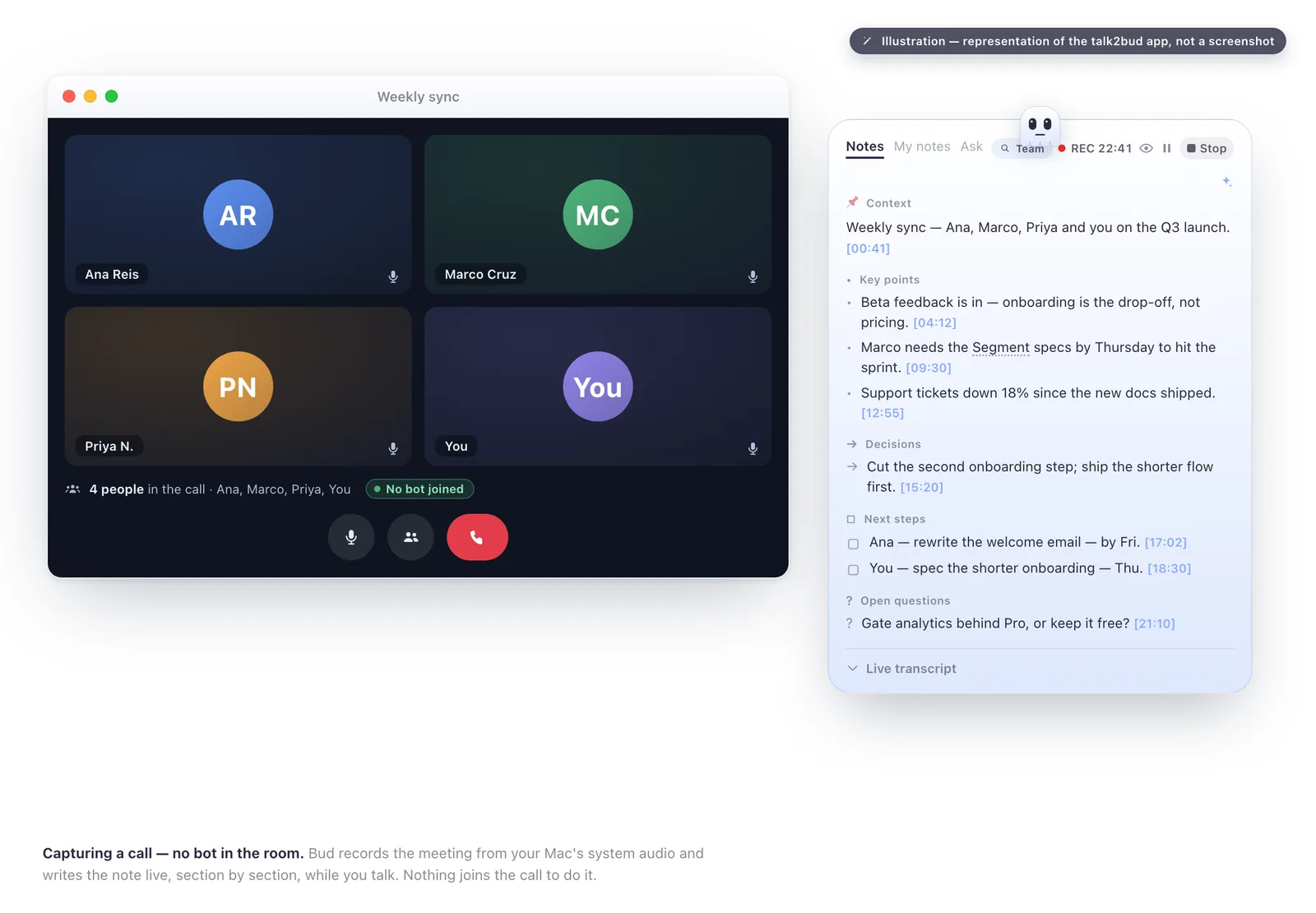
The opener told the record what to keep; the Lens checks whether the meeting delivered it. talk2bud runs on a Mac, in English, and it is built to read the conversation rather than to run the meeting for you. If capture is the piece you have not solved, the guide to recording a meeting without a bot in the room covers it end to end.
Take the Opener Sheet With You
All five beats, the seven openers, and the filled example on one page: download the meeting introduction template (PDF, 2 pages, 290 KB). It is published under CC BY 4.0, so print it, edit it, drop it in your onboarding doc, as long as talk2bud gets the credit.
Meeting Introductions, Answered
What is the best way to start a meeting?
Open a meeting by stating its purpose in one sentence before anything else: name the outcome it owes, then the decision on the table as a yes-or-no question. Hold the logistics and small talk until after the purpose has landed. Harvard Business Review found 71% of 182 senior managers call meetings unproductive, and a missing purpose is the most common reason. A strong opener also names who takes the notes and where the decisions go once the call ends.
How do you introduce yourself in a meeting?
Introduce yourself with your name, your role in one line, and the reason you are in this specific meeting, not a full history. For example: "I'm Priya, I own onboarding, and I'm here to flag the two accounts that are at risk this quarter." The reason is the part that earns attention. When the group already knows each other, skip the introduction and open with the meeting's purpose instead.
What should you say in the first 30 seconds of a meeting?
In the first 30 seconds, say why the meeting exists and what it will produce: "By the end, we'll have decided this." State the decision as a question, so the notes later show whether the meeting settled it. Then, in one line, name who is taking notes and where the decisions will land. Save agenda detail and introductions for after that opening.
How long should a meeting introduction be?
A meeting introduction should take about a minute, and rarely more than two. It frames the meeting; it is not the meeting itself. Facilitation guidance broadly agrees that a preamble past two minutes signals you don't respect people's time. Five beats fit inside a minute when said plainly: the outcome, the question you're deciding, the people, the time plan, and where the record goes.
How do you make meeting introductions more engaging?
Make a meeting introduction more engaging by tying the purpose to something the room cares about and by involving someone early, so the opener is not a monologue. Leadership Strategies' IEEI opening (Inform, Excite, Empower, Involve) is built on that idea. The most reliable engagement move is also the simplest: state a real decision the meeting will make, because people pay attention when their input changes an outcome, not when they are being updated.
Can AI help with meeting introductions?
AI will not write a good opener for you, because the outcome and the decision are things only you know before the meeting starts. What a tool can do is close the loop afterward: talk2bud captures the call from your Mac's system audio, with no bot in the room and consent kept explicit, and reads the transcript against a Lens to check whether the meeting decided what the opener promised. The introduction sets the terms; the software checks they were met.
Verified August 2026 against the sources linked above: Harvard Business Review's "Stop the Meeting Madness," Steven Rogelberg's The Surprising Science of Meetings, Leadership Strategies on the IEEI opening, Lucid Meetings on leading introductions, and Google's Workspace announcement on explicit consent. This is document review, read on 13 August 2026, and every number here carries the page it came from.
If the Opener Should Grade Itself
Pick one meeting on your calendar this week and rewrite its first minute as the five beats: the outcome, the decision, who's here, the time, and where it lands. Then, for the calls you run from your Mac, let a Lens read the meeting back and tell you whether it decided what you promised in the opener. The opener is only half the front matter; the other half is the agenda it introduces, and the rest of the meeting templates in the library are built on the same idea. Say the terms out loud, and keep the record of whether you met them.