The Customer Success OKR Rubric (And What Churn Sounds Like)
A behavioral 1-to-5 rubric for customer success OKRs, scored by lifecycle stage, plus the audible churn signal and an annotated example call.
The Customer Success OKR Rubric (And What Churn Sounds Like)
Search "OKR customer success" and every result hands you the same scoreboard. Objective: improve retention. Key results: lift net revenue retention to 110%, cut logo churn to 5%, raise CSAT to 95%. The lists are tidy, and every one of those numbers is lagging. You find out whether you hit them exactly once, at the end of the quarter, by which point the renewal has already drifted the way it was quietly heading for weeks.
A customer success OKR only moves retention when its key result is something you can hear on a call this week: whether onboarding reached a first outcome, whether adoption went past the one champion, whether the customer can say the value back in their own words, whether the renewal is a conversation you started or an ambush you are walking into. Those are audible. Either the customer said them out loud or they did not.
This piece scores customer success calls with six criteria, each pairing what a weak answer sounds like against a strong one, each weighted to a stage of the customer lifecycle, so two people reviewing the same QBR land on the same number. It adds one thing the OKR listicles do not have, the part that predicts a cancellation before any dashboard turns red: the audible churn signal, the sentences that tell you an account is leaving while the health score still says green.
It is also how talk2bud reads a customer call. The app captures the conversation from your Mac's system audio, with no bot joining the meeting, and reads the transcript against a customer success Lens that returns the six scores and flags every churn signal from what was actually said. No bot in the room is a capture choice, not a license to record quietly: you still let the customer know it is being recorded, which is the honest version and the one the app keeps explicit. The rubric below and that Lens are the same object.
Everything here was verified in August 2026 against the sources linked inline: SaaS Capital's 2025 retention benchmarks, and customer-health guidance published by Gainsight and ChurnZero.
Why The Number On The Dashboard Is Always Late
Net revenue retention is the number every customer success OKR points at, and for good reason. In SaaS Capital's 2025 retention survey (published September 2025), private B2B SaaS companies in the $25,000 to $50,000 ACV band posted a median net revenue retention of 102%, a top quartile of 111%, and a bottom quartile of 97%. Higher retention tracked higher growth, because net retention folds in the upsells and expansions that grow revenue year over year. So the "get NRR to 120%" you read on OKR templates sits well above where most private SaaS lives. The real bar is closer to 100, and every point above it is fought for.
Here is the problem with pointing an OKR at that number. NRR is a lagging indicator. It confirms, at quarter close, what your accounts already decided in dozens of calls you did or did not run well. Gainsight and ChurnZero both make the same argument about health scores: the signals that predict churn early are behavioral, things like feature adoption and onboarding completion, while satisfaction scores like CSAT and NPS mostly confirm a trend after it has set. A customer success OKR built on lagging numbers is a thermometer pointed at a fire that started last month.
The fix is not a better metric. It is scoring the leading indicator you already have, sitting untranscribed in every onboarding call, QBR, and renewal conversation. What follows turns that into something you can grade.
The One-Page Version
The method fits on an index card. Open your last customer call, whatever stage it was. Give each of the six criteria a 1 to 5 based only on what was said, and write the quote that earned the score. The two lowest criteria are your next quarter's OKR, phrased as a behavior instead of a number: not "raise NRR," but "every QBR ends with the customer naming a dollar outcome."
Then run the churn read separately. Count the loud signals and the healthy ones. An account can score a friendly 4.0 on the rubric and still be a high churn risk if the champion said "I'm moving teams" and nobody heard it as the thread being cut. The full playbook, with anchors for all five score bands, the churn-signal catalog, and a 30-day rollout, is in the download section below, as a PDF and an importable Lens.
The Customer Success OKR Rubric
A checklist asks "did you talk about value?" and a manager who said the word value ticks the box. A rubric asks what a 2 sounds like against what a 5 sounds like, with the phrasing attached, so the score survives a second reviewer and a bad mood. That property is the only reason it is worth running twice.
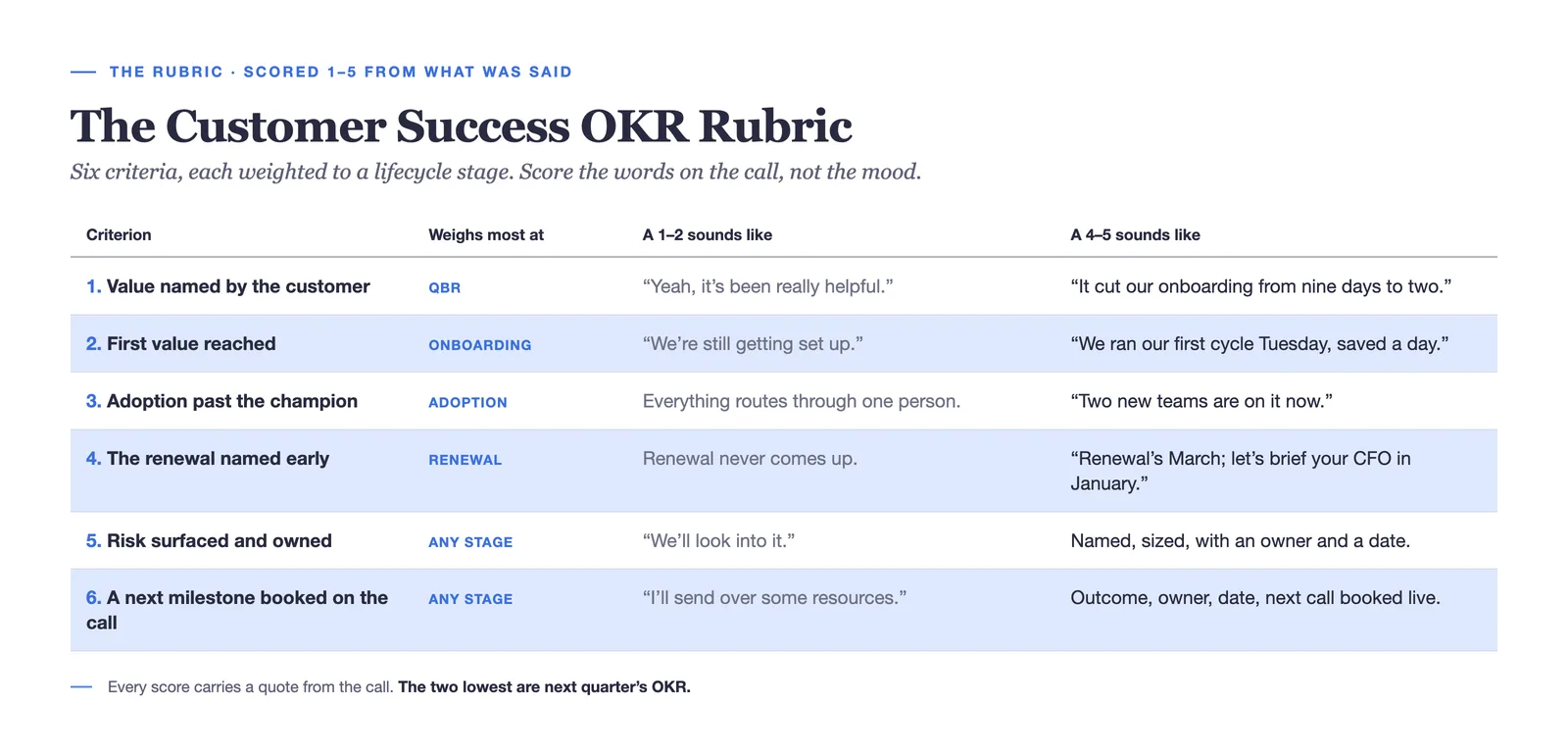
Here is the full rubric, in a form you can copy into your own notes. Score each row 1 to 5, and quote the line that earned it.
| Criterion | Weighs most at | A 1-2 sounds like | A 4-5 sounds like |
|---|---|---|---|
| 1. Value named by the customer | QBR / value review | You assert the value and they agree. "Yeah, it's been really helpful." | They quantify it, unprompted. "It cut our onboarding from nine days to two, so we stopped losing trials in week one." |
| 2. First value reached | Onboarding | Setup talk with no outcome. "We're still getting everyone's logins sorted." | A concrete first result and a date. "We ran our first cycle Tuesday and it saved the ops team a day." |
| 3. Adoption past the champion | Adoption / mid-term | Everything routes through one person. "I'm the only one really in there so far." | A second name, a second team. "I've got two new teams on it now, and Ops is asking for seats." |
| 4. The renewal named early | Renewal / expansion | Renewal never comes up, or gets sprung in the final month. | It is on the table with time to work it. "Renewal's in March, so let's get your CFO the numbers in January." |
| 5. Risk surfaced and owned | Any stage | A complaint absorbed. "We'll look into it." | Named, sized, assigned. "That export bug is costing you an hour a week. I own it, fix by Friday, I'll confirm Thursday." |
| 6. A next milestone booked on the call | Any stage | A vague forward promise. "I'll send over some resources." | An outcome, an owner, a date, the next call booked live. "You enable SSO by the 12th, I bring the adoption report, we meet the 15th." |
Criterion 1 is the one most teams overweight in their feelings and underweight in their scoring. A customer who is warm, responsive, and delighted, but who has never once said what the product did for them in a number, is an account with no articulated reason to renew when their budget gets scrutinized. Delight is not value. Value is a sentence the customer can say to their own boss, and you can hear whether they can.
What Churn Actually Sounds Like
The rubric grades the health of a call. The churn signal grades the risk in it, and it runs on different rules. A high rubric score with a loud churn line is still a losing account, so you read them side by side.
Churn rarely announces itself as a cancellation. It shows up as a change in how the customer talks, weeks before the notice email. The tell is not tone. A frustrated customer who is still fighting for the tool is safer than a polite one who has quietly moved on. The tell is in the words, and it sorts cleanly into three volumes.
| What you hear | What it reads as | Volume |
|---|---|---|
| "We're re-evaluating our tools this quarter." | An active shopping trip you were not invited to. | Loud |
| "My VP asked what we're actually paying for this." | Budget scrutiny reached someone who never saw the value. | Loud |
| "Sarah is moving to a new role next month." | Your single thread is about to be cut. | Loud |
| "We just haven't had the time to roll it out." | Adoption stalled, and nobody owns restarting it. | Rising |
| "We'll get to it." (the passive future, no owner, no date) | A commitment that will not survive the week. | Rising |
| The champion stops saying "we" and starts saying "you." | The customer no longer files your product under theirs. | Rising |
| "Can you help me bring the design team on next month?" | Adoption is spreading past the champion. | Healthy |
| "It saved us about a day a week last month." | Value, named, with a number, unprompted. | Healthy |
Score the churn read 1 to 5 for risk: a 5 is any call with a Loud line and no Healthy ones, a 1 is a call carrying two or more Healthy signals and nothing above it. The pronoun shift is the one most people miss and the one that predicts best. When a champion who used to say "our rollout" starts saying "your tool," the account has already begun the internal process of not owning you, and that happens on the call long before it happens on the invoice. This is the kind of line a Lens surfaces and a person misses, because the app scores the sentence and never hears the friendly tone that talks a human reviewer out of the flag.
What The Scores Sound Like On A Call
Below are two short excerpts from a mid-contract check-in. They are illustrative examples written to show the scoring, not real transcripts, and they are dated the way a real review would be: a check-in from 11 August 2026. The margin notes are what the rubric and the churn read write.
Them: Honestly, things are good. The team likes it, no complaints from my side. You: Love to hear it. Anything you want to see next? Them: Not really. We haven't had a ton of time to dig into the newer stuff. Oh, and heads up, I'm actually moving over to the platform team next quarter, so someone else will pick this up. You: Congrats on the move. Well, you know where to find me if anything comes up.
Criterion 1, score 2. "The team likes it" is warmth with no outcome attached, and nobody pushed for one. Criterion 3, score 1. The champion is leaving and no successor was named, sized, or introduced. That "someone else will pick this up" is the single thread being cut in real time. Churn read, score 5. Two Loud signals in four lines: a champion departure and stalled adoption ("haven't had time"), and the call ended by wishing them well instead of protecting the account. This is the friendliest churn you will ever hear.
Now the same moment, run well.
Them: Good, honestly. The team's happy, no real issues. You: Glad it's landing. Before we go on, can you put a number on it? When your VP asks what this is worth, what do you tell her? Them: Fair. Probably that it's cut our onboarding from about nine days to two. You: That's the line I'd protect. One more: you mentioned you're moving to the platform team. Who picks this up, and can we get thirty minutes with them before you go? Them: Good call. Let me bring in Marcus, he runs the day-to-day now anyway.
Criterion 1, score 5. The value is named, with a number, in the customer's own words, and it is exactly what they will say in a budget meeting. Criterion 3, score 4. The single-thread risk got caught and a warm handoff to Marcus got booked on the call. Same customer, same mood, a renewal that now has a champion and a number attached instead of a goodbye.
The difference between those two calls is not skill at rapport. Both reps were liked. The difference is that one of them scored the account while it was still on the line, and asked the two questions the rubric flags as unanswered.
Calibration: Two Reviewers, One Number
A rubric earns its keep only if two people reading the same call land within a point of each other. When they do not, the argument is almost always about an adjective, not a fact. Calibration settles it by making everyone point at the quote.
Try it. Score criterion 1 on this exchange from a QBR, then read the key.
You: So overall, happy with where things are? Them: Yeah, really happy. The team's using it every day, it's become part of how we work. You: Amazing. Let's talk about next quarter.
Score it before reading on. The answer is a 2. A reviewer who enjoyed the call wants a 4, because "part of how we work" sounds like deep adoption and the customer was plainly happy. Criterion 1 is not "did they sound happy." It is "did the customer name the value, ideally as a number." Daily usage is an activity, not an outcome, and "part of how we work" is a feeling with no dollar, hour, or result behind it. Health is not a mood. It is a set of sentences, and either the customer said them or they did not, which is the one fact a second reviewer and a Lens reading the transcript can both point at.
The rule that keeps calibration honest is the quote rule: no score without a line from the call under it. A score with no quote beneath it is a guess wearing a number, and the moment two reviewers argue about the quote instead of the vibe, the gap closes on its own. It is the same discipline behind writing a self-review from evidence rather than adjectives: the reviewer only trusts what you can point at.
How The Rubric Shifts By Stage
The six criteria hold across the customer lifecycle, but their weight moves, which is what makes this a rubric by stage rather than a flat checklist.
On an onboarding call, criterion 2 is nearly the whole score. An account that never reaches a first outcome is, in ChurnZero's phrase, functionally pre-churned, so a kickoff that ends without a dated first result has already lost time it will not get back. At mid-term and adoption, criterion 3 carries the risk. Single-threaded accounts die the moment their one champion changes jobs, and the fix is to widen adoption on purpose while the relationship is still warm. At the QBR, criterion 1 dominates, because the QBR exists to convert usage into a value the customer can articulate to their own leadership. In the renewal window, criterion 4 leads: a renewal you name in January is a negotiation, and a renewal you discover in the final week is a fire drill.
Segment changes the shape too. In high-volume SMB success, where one manager covers hundreds of accounts, the churn read matters more than the value narrative. In enterprise, multi-threading is not optional, so criterion 3 is graded hardest, and a single-threaded seven-figure account is an open risk no matter how happy the champion sounds.
The Four Ways Reviewers Score This Wrong
A rubric removes most bias. Four failure modes survive if you let them, and each has a specific fix.
The smile bias. The customer was warm, so every criterion drifts up. This is the exact error a health score built on CSAT makes at scale: it reads satisfaction as safety. A delighted customer who never named a value and whose champion is leaving is one of the most expensive accounts you can carry, because everyone feels good about it until the day it cancels. Score the words, then let the mood be a footnote.
Recency. You remember the last two minutes and grade the whole call on the goodbye. A warm sign-off inflates a check-in that surfaced no value and named no next step. Fix it by scoring criterion by criterion, in order, before forming an overall impression.
Halo. One strong answer, usually a great value quote, pulls every other score up with it. A customer can articulate sharp value and still be single-threaded and unrenewed. Score each criterion against its own anchor, not against your impression of the account.
Severity and leniency. Two reviewers who run hot and cold produce numbers that cannot be compared. The anchor text is the cure: when a score has to point at the sentence a 2 or a 5 sounds like, personal strictness stops deciding the outcome.
Rolling It Out In 30 Days
Week one is a pilot. Score your own last five customer calls without changing how you run them, just to get a baseline and find your weakest criterion. Most teams find it is criterion 1 or criterion 4, value and renewal timing, the two that quietly decide NRR.
In week two, calibrate. Have a colleague score two of the same calls, and anywhere you disagree by more than a point, argue it to the quote until the anchor settles it. By week three, every live customer call goes through the rubric and the churn read, and you report two numbers each Friday: the criterion averages and the count of accounts carrying a Loud churn signal. The final week is for reading the trend. If criterion 3 stays low across a segment, the problem is not coaching, it is that multi-threading was never anyone's explicit job.
The habit that does the quiet work here is opening each call on the last one's commitments, the same loop that turns a recurring meeting agenda from a treadmill into a line that moves. The rubric just gives that loop a number, and the churn read gives it an early warning.
Running The Rubric On The Call You Just Had
You will not score every customer call by hand forever, and the whole point is to run the rubric on all of them without adding an hour of admin to a week that is already behind. Here is the path from a live call to a score.
1. Capture the call without a bot in the room. talk2bud records from your Mac's system audio, so nothing joins the meeting as a participant and no bot shows up in the attendee list. That is a capture choice, not a secrecy one. No hidden bot is not the same as recording in secret, so you still tell the customer you are capturing the call and keep the consent the app treats as explicit. On a success call, the honest line is short: "I record these so I can focus on you instead of my notes, all right with you?" How the system-audio capture works, and why it holds the customer's side of the call that a screen recorder drops, is worth a read on its own.
2. Pick the customer success Lens. In Modes, switch to Call lenses and pick the one that fits, or press New, name it Customer success, and paste in the rubric from this page as its playbook. The Lens is the rubric: the same six criteria, the same churn catalog, the same quote rule.
3. Read the score, not the recording. When the call ends, talk2bud scores the transcript against the Lens and lays the analysis out by section, with owners and deadlines pulled straight from what was said. You read a page, not a forty-minute recording, and the churn lines are flagged with the sentence that raised them.
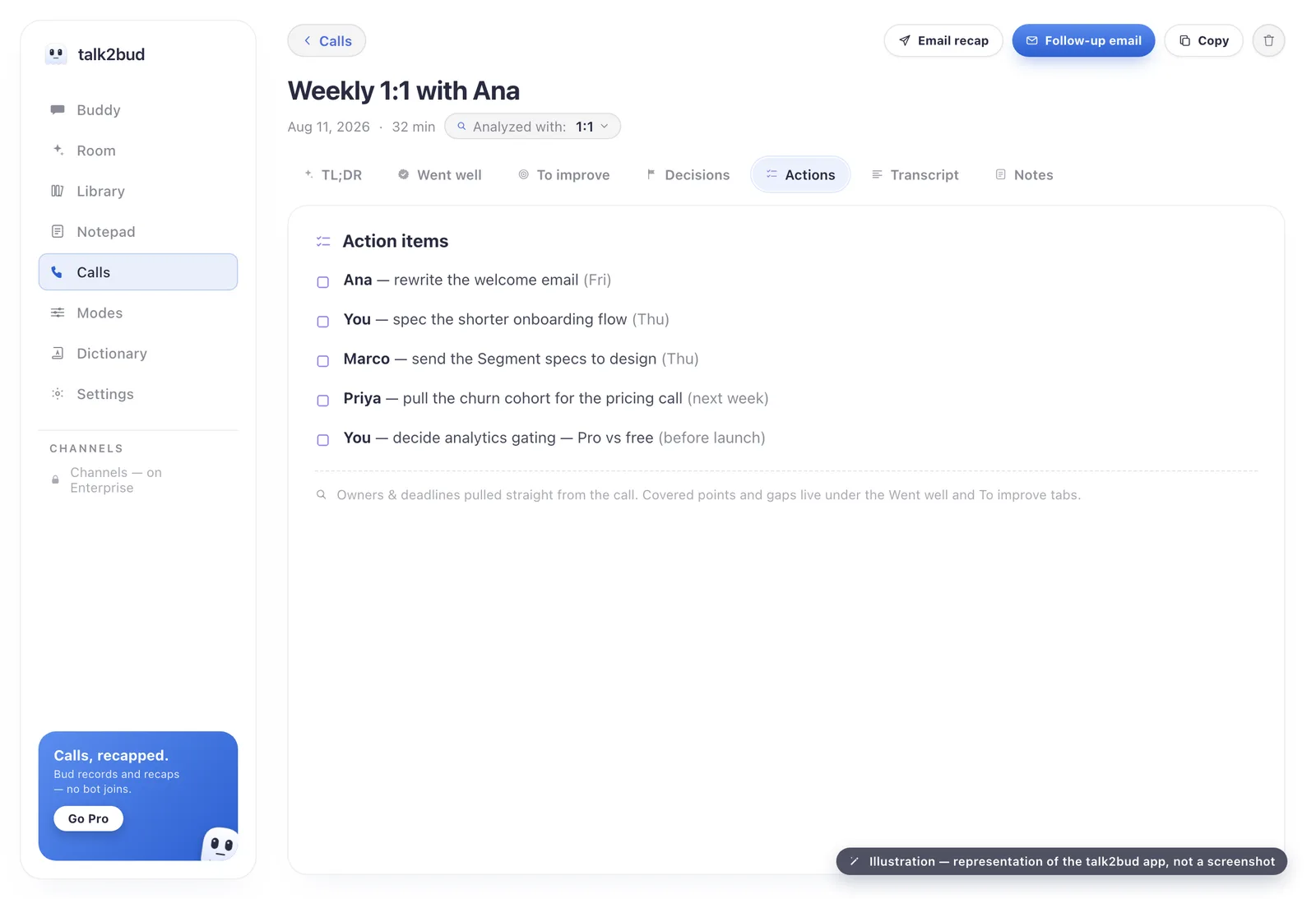
That last part is the reason to run it on the machine instead of in your head. A human reviewer forgets the "someone else will pick this up" line by the time the call is over. A Lens reading the transcript does not, and it flags the churn signal for you before the renewal date does. One next step, if you do nothing else with this page: point the Customer success Lens at the last QBR or renewal call you ran, and read the churn score before the account makes the decision for you.
Download The Customer Success OKR Playbook
The full playbook is free, under a CC BY 4.0 licence, so you can adapt it and re-share it with attribution.
- The Customer Success OKR Playbook (PDF, 10 pages). The thesis, all six criteria with anchors for every score band, the audible-churn catalog, the calibration read, and the 30-day rollout. Download the PDF.
- The importable Lens (Markdown). The same six criteria and churn signals as a file talk2bud imports as a call Lens. In the app, go to Modes, then Call lenses, then New, and import it. Download the Lens file.
There is no email gate. The playbook and the Lens are the same criteria, so the score you give a call by hand and the score the app gives it come from one rubric.
Frequently Asked Questions
What are OKRs for customer success?
OKRs for customer success are quarterly goals written as an Objective (a qualitative aim like "make customers reach value faster") paired with two to four Key Results that measure it. Strong customer success OKRs point their key results at leading indicators you can influence week to week, such as onboarding completion or value named in QBRs, rather than only at lagging outcomes like net revenue retention that confirm the result after the quarter closes.
What is an example of a customer success OKR?
A common example is: Objective, improve customer retention; Key Result, increase net revenue retention from 102% to 110%. That is a valid target, but a lagging one. A more actionable version adds a leading key result you can hear on calls, such as "90% of QBRs end with the customer stating a quantified outcome" or "every onboarding reaches a first measurable result within 14 days." Those are the behaviors that move retention before the quarter closes.
What is the difference between OKRs and KPIs in customer success?
A KPI is a standing metric you monitor continuously, such as churn rate, NRR, or CSAT. An OKR is a time-boxed goal for a specific quarter, written as an Objective plus the Key Results that would prove you reached it. In customer success, NRR is a KPI you always watch, while "lift NRR from 102% to 108% this quarter by fixing onboarding" is an OKR. KPIs tell you the current state; OKRs commit you to a change in it.
What are the leading indicators of customer churn?
Leading indicators of customer churn are early behavioral signals that appear before a cancellation, unlike lagging indicators such as a low NPS that confirm the trend after it sets. Common ones include stalled onboarding, adoption concentrated in a single champion, a drop in product usage, a downgrade from annual to monthly billing, and a departing champion. On calls, they are audible: a customer saying they are re-evaluating tools, that they have not had time to roll it out, or shifting from "our rollout" to "your tool."
How many OKRs should a customer success team have?
Most guidance recommends two to three objectives per quarter for a customer success team, each with two to four key results, and no more than three to five OKRs per individual. Fewer, sharper objectives beat a long list, because a team trying to move every metric at once moves none of them meaningfully. Pick the two lifecycle stages where your accounts leak most, usually onboarding and renewal, and write the quarter around those.
Verified August 2026 against SaaS Capital's 2025 private SaaS retention benchmarks (published September 2025), and customer-health guidance from Gainsight and ChurnZero. Figures are quoted from those sources; the call excerpts are composed examples that demonstrate the scoring, not recordings of real customers. This is general guidance on measuring customer success, not a promise about any account's outcome.