Minute taking examples: three meetings, written out in full
Finished minutes from three very different meetings, marked up so you can see what each document owes its reader, and the empty version underneath each one.
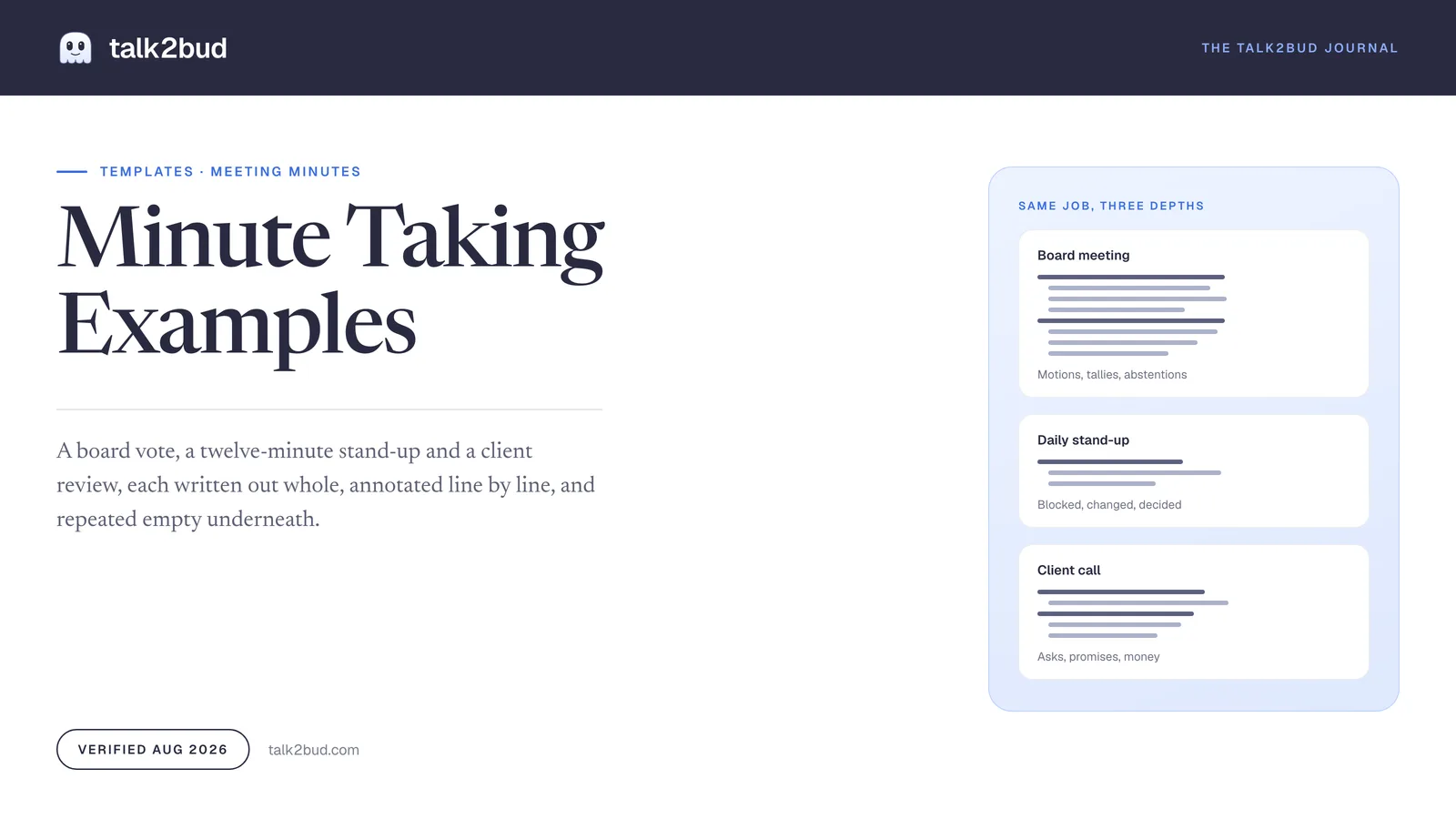
Minute Taking Examples, Filled In And Annotated For Three Meetings
Anyone searching for minute taking examples has already found the blank tables and learned nothing from them, because an empty grid never says how much to write down. Three finished documents follow, a board meeting, a daily stand-up and a client call, each one written out whole, annotated line by line, and then repeated empty so you can copy the shape.
Depth is decided by whoever opens the document later. Board minutes are a legal record, so they carry motions, votes and abstentions and almost no discussion. Stand-up minutes carry three lines, or none. Client call minutes carry what was actually said, because there is no vote to record and the words are the only thing standing between two versions of the same agreement.
That split is also why the person typing is the wrong instrument. Choosing what survives is an editing job, and editing is impossible while you are also listening, arguing and watching the clock. talk2bud captures the conversation off your Mac's system audio, so what you are left holding is the edit rather than the transcription. No bot joins the call to do it, which is exactly why saying so to the room stays part of the job; capturing without a bot is not the same as capturing quietly. Every organisation, person and number below is invented for this page.
The Board Meeting, Written Out In Full
An illustrative example. Harbor Line Coffee Roasters is a composite, not a real company, and nobody named here exists.
HARBOR LINE COFFEE ROASTERS, INC.
Minutes of the regular meeting of the Board of Directors
14 July 2026, 09:00 to 10:12 · video conference

Present:      D. Alvarez (Chair), M. Okonjo, S. Petrov, R. Lin, J. Haddad
Absent:       T. Vance, notice given
Also present: A. Ferreira (Secretary); K. Doyle (CFO), item 3 only
Quorum:       present throughout

1. Call to order
   The Chair called the meeting to order at 09:00.

2. Minutes of the previous meeting
   The minutes of 9 June 2026 were approved as corrected: in item 4,
   "eighteen months" replaced "twelve months".

3. Q2 financial statements
   The CFO presented the Q2 statements. Motion: to approve the Q2
   financial statements as presented. Moved by M. Okonjo, seconded by
   R. Lin. Carried, 4 in favour, 0 against, 1 abstention (S. Petrov,
   citing a supplier relationship with the audit firm).

4. Dock Road lease
   Motion: to authorise the CEO to sign a five-year lease at 22 Dock
   Road at a rent not exceeding $18,500 per month. Moved by R. Lin,
   seconded by J. Haddad. Carried unanimously.
   Action: A. Ferreira to file the executed lease with the corporate
   records by 31 July 2026.

5. Any other business
   None.

6. Adjournment
   The Chair adjourned the meeting at 10:12.

Minutes taken by A. Ferreira, Secretary. Draft circulated 15 July 2026.
The header says which kind of meeting this was. Regular, special or annual changes what notice was required and therefore whether the business transacted was valid. A reader in 2031 needs that word before anything else.
Absences, quorum and the abstention all carry their reason. These four lines are the ones nobody can reconstruct from memory six weeks on, and they are the reason the document exists at all. California's corporation code puts it plainly: every corporation "shall keep minutes of the proceedings of its shareholders, board and committees".
"Approved as corrected" is a term of art, not a flourish. The official Robert's Rules FAQ describes exactly this move: you fix the old document itself, in the meeting that adopts it, and the new document says so.
There is no discussion anywhere in the document. That is the rule the top results on this topic quote and rarely demonstrate. Robert's Rules is blunt about it: "Minutes are a record of what was done at a meeting, not a record of what was said." Summarising the debate is not a bonus, it is an error, and item 3 shows what disciplined looks like: a motion, a mover, a seconder, a tally.
One action item, with a name and a date. Filing the lease is an act, so it belongs here. If the board had merely agreed that somebody should look into leases, that sentence would be cut and the thought would move to the agenda for next time.
The Same Board Minutes, Empty
{ORGANISATION}
Minutes of the {regular / special / annual} meeting of the {body}
{date}, {start} to {end} · {room or platform}

Present:      {names, chair first, roles in brackets}
Absent:       {names, and whether notice was given}
Also present: {non-members, and for which items}
Quorum:       {held throughout / lost at item N}

1. Call to order
   {who opened, at what time}

2. Minutes of the previous meeting
   {approved as read, or approved as corrected plus the correction}

3. {item}
   Motion: {the wording that was voted on, not a paraphrase}
   Moved by {name}, seconded by {name}.
   {Carried / Failed}, {tally}. {Abstention and its stated reason}
   Action: {owner} to {act} by {date}

{N}. Any other business
   {items, or None}

{N}. Adjournment
   {who closed, at what time}

Minutes taken by {name}, {role}. Draft circulated {date}.
The Stand-Up, Written Out In Full
Before the example, the honest part. The 2020 Scrum Guide defines the Daily Scrum as "a 15-minute event for the Developers of the Scrum Team" and prescribes no documentation for it whatsoever, leaving the team free to pick any structure. Most days the correct set of stand-up minutes is nothing at all. What follows is the residue worth keeping on the days something moved, written for the one person who was on a plane.
Payments squad · daily stand-up · 14 Jul 2026, 09:32 to 09:44

Blocked
  Card tokenisation waiting on the vendor sandbox key. Owner: Priya.
  Chased twice this week; escalating to the account manager if
  nothing lands by Wednesday.

Changed since yesterday
  Refund flow moved to staging, so the Friday release is now Thursday.

Decided standing up
  Currency rounding bug ships as a hotfix instead of waiting for the
  next sprint. Dan and Priya, no dissent.

Not recorded: everything else.
Three headings, and the last line is a policy. "Not recorded: everything else" tells the next reader that silence means nothing happened, which is what makes a short document trustworthy. Without that line, a thin entry reads as a lazy entry.
Every line answers the same test. Would a teammate returning tomorrow be wrong about something if this were missing. Status updates fail that test, which is why nobody's yesterday appears here.
A decision made outside a meeting is still a decision. The hotfix call was made standing up, in twelve minutes, and it changes what ships. Losing it costs more than the whole document costs to write, and it takes about forty seconds to type.
If your stand-up notes take longer to write than the stand-up took to run, the meeting has quietly turned into a status report and an agenda built out of the questions the hour must answer will save more time than better minutes will.
The Stand-Up Skeleton, Empty
{squad} · daily stand-up · {date}, {start} to {end}

Blocked
  {what is stuck, on whom or what}. Owner: {name}.
  {what was already tried; the trigger for escalating}

Changed since yesterday
  {the fact a returning teammate would otherwise get wrong}

Decided standing up
  {the call made without a meeting, and who made it}

Not recorded: everything else.
The Client Call, Written Out In Full
Here the parliamentary rule inverts. No motion is put, nothing is seconded, and six weeks later the argument will be about what somebody meant. In this document the words are the record, so the quote stays in. Another illustrative example: Vellum Studio and Rowan Dental Group are invented, and so is everything they say.
Vellum Studio · Rowan Dental Group · project review call
14 Jul 2026, 15:00 to 15:38 · Google Meet
Vellum: J. Mbeki (account), L. Ferrand (design)
Rowan:  C. Whitlock (marketing director), H. Ostrom (operations)

What the client asked for
  C. Whitlock: patients should be able to reschedule in the booking
  flow without phoning the desk. Named it the priority for the
  September campaign, and wanted the homepage live first, "or the
  ads point at the old one".

What we said we would do
  L. Ferrand to send two reschedule flows by 18 July.
  J. Mbeki to price them as a change request, because the signed
  scope covers booking only. Said so on the call; C. Whitlock agreed.

What we ruled out
  Patient records integration stays out of this phase. H. Ostrom
  accepted and asked for it to be scoped separately in the autumn.

Where the money moved
  Change request estimated at 12 to 16 hours, quote due 18 July.
  Nothing was approved on this call.

What is at risk
  The campaign date is fixed and the homepage waits on copy Rowan
  still owes. Raised on the call; C. Whitlock to send copy by 25 July.
The five headings are the five questions this call gets asked later. What did they want, what did we promise, what did we refuse, what will it cost, and what could still break it. An agenda-shaped document would have buried all five under "AOB".
The quote is load-bearing. Whitlock's line about the advertising pointing at an old homepage is a deadline expressed as a consequence, and paraphrasing it into "client requested homepage priority" throws away the reason the date cannot move. A board secretary would strike it correctly; here, striking it is the mistake.
The refusal is written down as carefully as the promise. Most scope disputes start with something everyone remembers hearing and nobody wrote, so the section that keeps an agency solvent is the one about what stays out.
"Nothing was approved on this call" protects both sides. It tells your finance colleague not to schedule the work, and it tells the client they have not been billed for a conversation.
Send it as the recap email the same day, in these words. Once the client has read it without objecting, it stops being your notes and starts being the record.
The Client Call Skeleton, Empty
{your company} · {client} · {call type}
{date}, {start} to {end} · {platform}
{your side}:   {names, roles}
{client side}: {names, roles}

What the client asked for
  {name}: {the ask, in their own words where the words carry weight}

What we said we would do
  {owner} to {deliverable} by {date}

What we ruled out
  {the exclusion, and who accepted it}

Where the money moved
  {change request, estimate, quote date, and what stayed unapproved}

What is at risk
  {the dependency, who owns it, by when}
Download All Three, Filled And Blank
Every document on this page, filled and empty, plus the depth table and the four liability lines, printed so you can hand it to whoever is taking notes next week: download the minute taking examples sheet (PDF, 5 pages, 326 KB). Published under CC BY 4.0, so copy, edit and reuse it as long as talk2bud keeps the credit. No email, no form, and the copyable versions stay right here on the page.
How Much Detail Each Document Owes Its Reader
| The meeting | Who opens it later | What it has to survive | Where the detail goes | First thing to cut |
|---|---|---|---|---|
| Board or committee | An absent director, an auditor, a lawyer, occasionally a court | Approval at the next meeting, and a reading years from now | Motions in their voted wording, tallies, abstentions with reasons | The debate. Robert's Rules treats summarising it as an error, not a service |
| Daily stand-up | The teammate who was on a plane | Tomorrow morning | Blockers, what changed, decisions taken standing up | Anything that was equally true yesterday |
| Client or agency call | The client, your finance colleague, whoever inherits the account | A scope argument six weeks from now | The ask in their words, both sets of commitments, the money not approved | Your private opinion of the client |
| Interview or 1:1 | The two people in the room, and nobody else by default | A decision about a person | Evidence and what was agreed | Impressions with no example under them |
| Any of the four, when nobody volunteers | You, on Friday, guessing | Your own memory of Tuesday | Read it off the recording and edit down to the row above | The assumption that a human has to type while listening |
Four Lines That Turn Minutes Into A Liability
Verbatim quotes in board minutes. A sentence somebody said while changing their mind reads, three years on, like a position they held all along. Keep the recording, which holds the argument in context, and let the approved document hold the decision.
"Discussed" doing the work of a verb.
Weak: The board discussed the Dock Road lease at length. Strong: Motion to sign five years on 22 Dock Road, ceiling $18,500 monthly. Carried unanimously.
The weak line records that time passed. The strong one records that a company just committed roughly a million dollars.
Action items with no owner, or no date. "Team to review pricing" is a wish. Every action line in all three examples above carries a name and a day, because an item without both is invisible to the person who has to chase it.
Adjectives about people. "H. was defensive about the timeline" is an assessment, not a record, and it will be read by someone you did not expect. Write the observable thing instead: the timeline was raised twice and no date was given.
Writing The Minutes From The Call Instead Of From Memory
Whichever of the three documents you owe, the raw material is the same conversation, and there is a version of this where nobody types during it.
Meet however you already meet. Zoom, Google Meet, Teams, whatever the invite says. talk2bud captures the conversation from your Mac's system audio, so no participant joins and the attendee list stays exactly as long as it was. Capturing without a bot is not a licence to capture in secret, and the fact that nothing announces itself is precisely why saying it out loud is the step that keeps the recording honest. The app treats consent as an explicit part of the flow for that reason, and the platforms are moving the same way: when Gemini takes notes in Google Meet, "a pencil icon appears on all participants' screens".
Pick the Lens that matches the meeting. A Lens is a short analysis playbook for one kind of call, and the built-in set covers the team sync, the 1:1, client discovery, the sales call and the interview. You can write your own, which is where the skeletons on this page earn their keep: paste the board or client-call shape in as the instructions and you have told the app what your organisation counts as minutes.
Read back the analysis and edit down. When the call ends, talk2bud evaluates the transcript against that Lens and returns what the playbook asked for: what was decided, who took what and by when, what got covered and what quietly did not. You cut it to the depth the table above says that document owes, which takes a couple of minutes and happens after the meeting, not during it. A 1:1 stays with the two people in it unless somebody deliberately sends it to a team Channel.
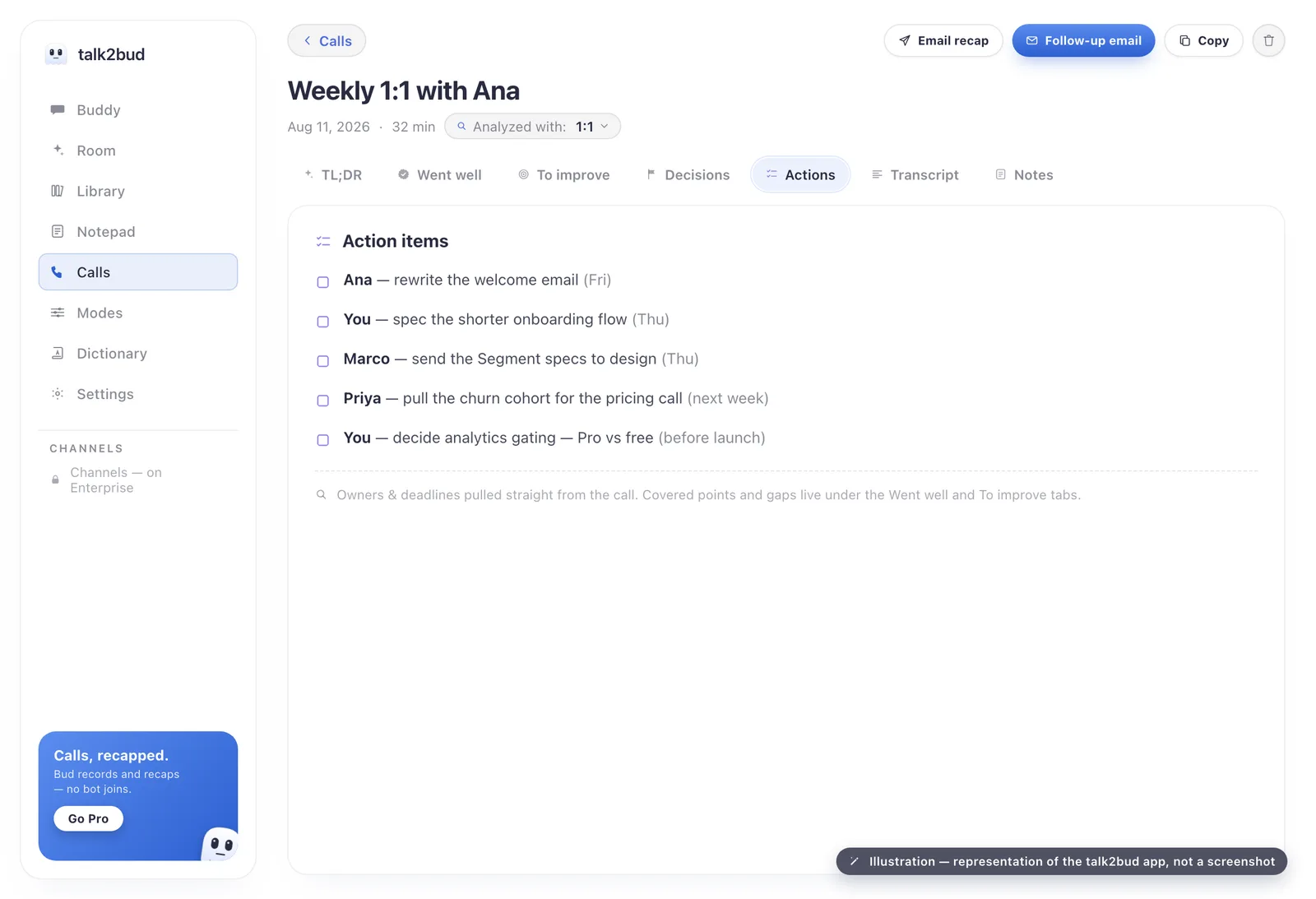
talk2bud is a Mac app, it works in English, and it is built to read the conversation rather than to format your document. With the record already captured, choosing what belongs in the minutes is a two-minute edit instead of a live guess. If the cost is the next thing on your mind, what talk2bud costs is one page. And if you have been relying on the chat window instead, the Zoom chat transcript leaves out more than people expect.
Minutes Questions That Come Up At The Second Meeting
How detailed should meeting minutes be?
Detail should match whoever reads the minutes later. Board minutes stay at the level of motions, votes and abstentions, because Robert's Rules of Order treats them as a record of what was done rather than what was said, and a corporate record may be read years later by an auditor or a court. Minutes of a daily stand-up or an internal sync can be three lines: what is blocked, what changed, what was decided. Client call minutes sit in between and keep the client's own words on scope and dates, since there is no vote to record.
What should never appear in meeting minutes?
Leave out the debate, personal characterisations, and verbatim quotes of board members mid-argument, because a sentence recorded out of context can be read back years later as a settled position. Leave out anything that is a wish rather than an act, such as "the team will review pricing" with nobody's name attached. In minutes of a board meeting, opinions expressed on the way to a decision are not part of the record; the motion, the vote and the tally are.
Do meeting minutes have to be approved?
Minutes of a board or a membership body are normally approved at the following meeting, and until then they are a draft. Under Robert's Rules of Order, a correction raised during approval is made in the minutes being approved and the record notes that they were approved as corrected. Informal minutes of a team meeting or a client call are not put to a vote, and the practical equivalent is sending the recap the same day so that anyone who disagrees says so while memories are fresh.
Can AI generate meeting minutes?
Software can now produce a draft: Google's "take notes for me" in Google Meet returns sections labelled Summary, Decisions, Next steps and Details, and became available to Google AI Pro and Ultra subscribers on 29 June 2026. What no tool decides for you is depth, which is a judgement about who reads the document next. talk2bud takes a different route by capturing the call from a Mac's system audio without a bot joining the meeting, then analysing it against a Lens you choose or write, so the draft arrives already shaped like the minutes your organisation keeps.
Who should take minutes at a board meeting?
The secretary of the board takes the minutes, and the minutes name whoever actually served in that role if the secretary is absent. That person should not also be the one running the debate, because chairing and recording at the same time is how tallies and abstentions get lost. Where the board records its meetings, the recording is the raw material and the secretary's real job is editing it down to motions, votes and actions.
Verified August 2026 against the sources linked above: the official Robert's Rules of Order FAQ, California Corporations Code section 1500, the 2020 Scrum Guide, and Google's documentation and announcement for note taking in Meet. This is document review, read on 13 August 2026, and every claim here carries the page it came from.
Who Writes These After Every Meeting
The documents are the easy part, and you now have three of them in both states. The question that decides whether any of it survives the month is who sits down after every board meeting, stand-up and client call to produce one, on the day, without being asked twice. If the answer in your team is nobody, capture the next meeting with talk2bud, run it against the Lens that matches it, and spend the two minutes editing instead of the forty writing. The rest of the meeting template library is built on the same division of labour.