Software Sales Enablement Without The Content Graveyard
Every result for this search is a list of platforms to buy. The part that decides whether enablement works is a weekly habit: turning a won call into a talk track reps reuse.
Software Sales Enablement Without The Content Graveyard
Search software sales enablement and the first screen is a shopping list. Nine tools, ten tools, eighteen tools, twenty-three tools, and a review directory sorted by star rating. Every one of those pages answers the question of what to buy, and none of them describes the week in which a program either takes hold or quietly stops being opened.
Sales enablement is the practice of giving a sales team the information, content, coaching and tools that help reps sell better, which is close to how Gartner frames it. Applied to software teams, it usually arrives as a platform that stores content, runs training, and reports on what gets used.
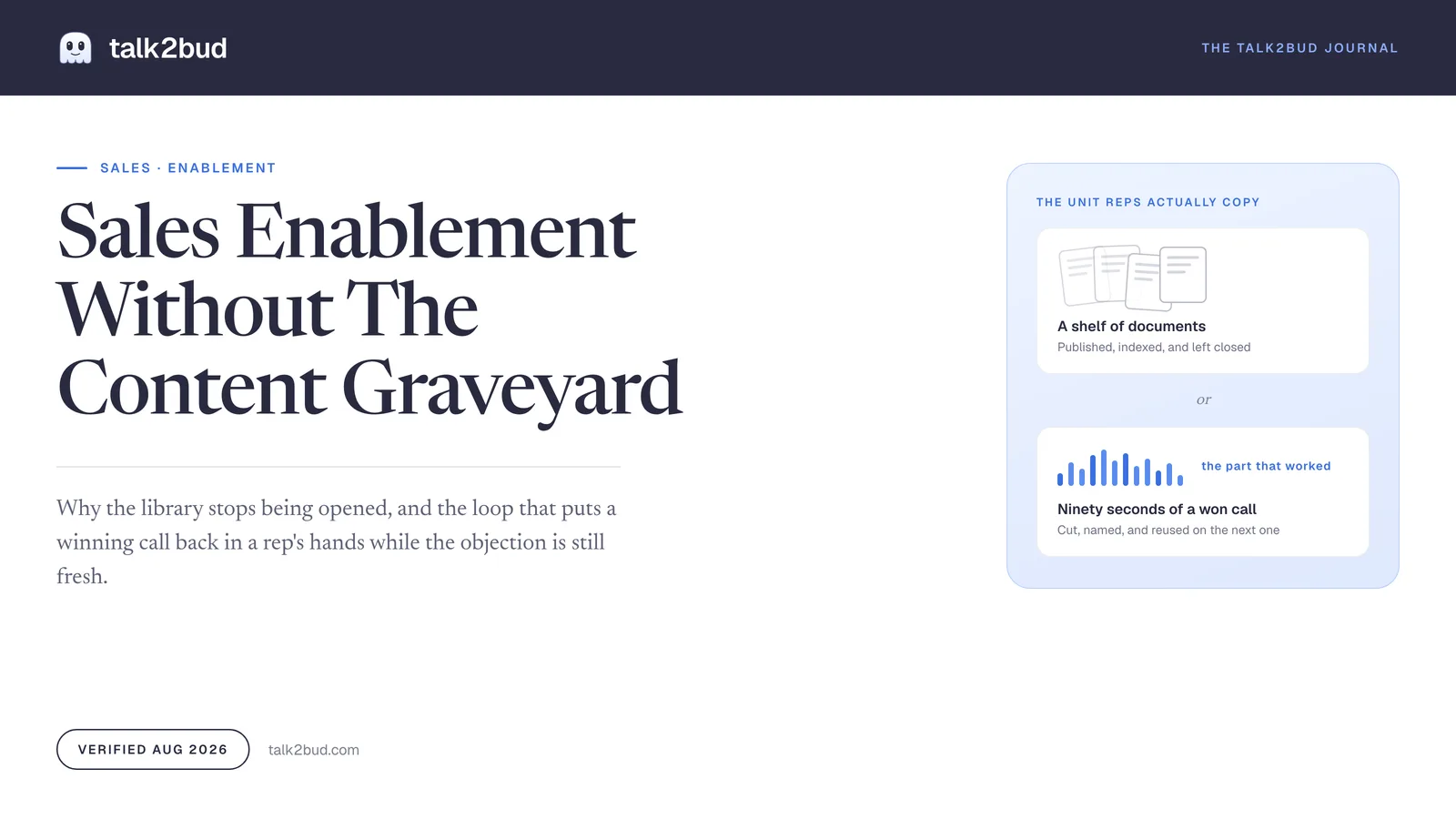
The reporting is where the trouble starts, because most programs report on what was produced. A shelf fills up. Attention does not. The material reps genuinely copy from each other is smaller and stranger than a document: it is the ninety seconds in which a teammate answered the objection that kills your deals, in their own words, on a call that was won. talk2bud exists because that raw material is usually thrown away, and everything below is built around keeping it.
How A Content Library Turns Into A Graveyard
Producing content is a project. It has a brief, a deadline, an owner and a launch note. Reusing content is a habit, and habits have none of those things, so the two sides of enablement drift apart from month one. The library grows every quarter because publishing is measurable; the opening rate falls every quarter because nobody is scored on it.
The survey numbers are blunt about the size of the gap. In the 2025 Impact of Enablement report, run by Spekit with the Sales Enablement Collective across more than 100 enablement professionals, 80% of respondents said roughly 40% of their platform's features go unused, and 48.8% said 40% or more of their sales content needs refreshing. Low adoption by reps was named by 55% as a key reason teams switch enablement platforms, which is a polite way of saying the tool gets blamed for a habit that was never built. Most respondents pay upward of $50 per user for the shelf.
Two facts from the last year make the shelf a worse bet than it looks. Seismic and Highspot, the two largest platforms in the category, signed a definitive merger agreement on 12 February 2026, with the combined company operating under the Seismic brand. Four months earlier, on 30 October 2025, Vector Capital closed its acquisition of Showpad, pairing it with Bigtincan under the Showpad name. Whatever library a team standardises on this year has a real chance of changing owner, roadmap or interface inside one contract cycle. A migration moves files. It does not move a habit, and it does not move the memory of what your best rep said in March.
Who Owns What, Next To Ops, Training, And Revenue Enablement
Half the confusion about this discipline is a boundary problem, and vendors do not clear it up because their categories overlap on purpose.
| Function | The question it answers | What it ships | Who feels it first |
|---|---|---|---|
| Sales enablement | Can a rep hold this conversation well? | Talk tracks, battlecards, coaching, onboarding paths | The rep on the call |
| Sales operations | Does the selling machine run? | Territories, comp plans, CRM hygiene, forecast plumbing | The manager in pipeline review |
| Sales training | Does the rep have the skill yet? | Curriculum, practice, certification | The new hire in week two |
| Revenue enablement | Can everyone who touches the customer hold that conversation? | The same work, extended to customer success, marketing and presales | The customer, at every handoff |
Gartner repositioned the category as revenue enablement in 2022, which is why "are these the same thing?" now appears in the FAQ block of nearly every vendor comparison. For a team of eleven reps the distinction is mostly academic: all four columns are one person's calendar, and that person is usually a sales manager who also carries a number. The useful boundary is narrower. Enablement owns what a rep can say next Tuesday. Operations owns whether the deal is recorded correctly afterwards.
Where The Word Came From, And What It Picked Up
The term is usually traced to 1999 and to John Aiello and Drew Larsen, who were chasing a sales execution problem: internal friction was eating the hours reps were hired to sell in (a short history of the discipline). Broad adoption arrived in the 2010s, alongside the content management platforms that took the name.
Something got swapped along the way. A discipline that began as "remove what stops a rep from selling" became "produce and store material for reps," because material can be bought, counted and put in a quarterly update. Friction cannot.
The Loop That Replaces The Library
The version that survives contact with a sales floor runs as a loop, and the unit that travels through it is a stretch of recorded conversation rather than a document.
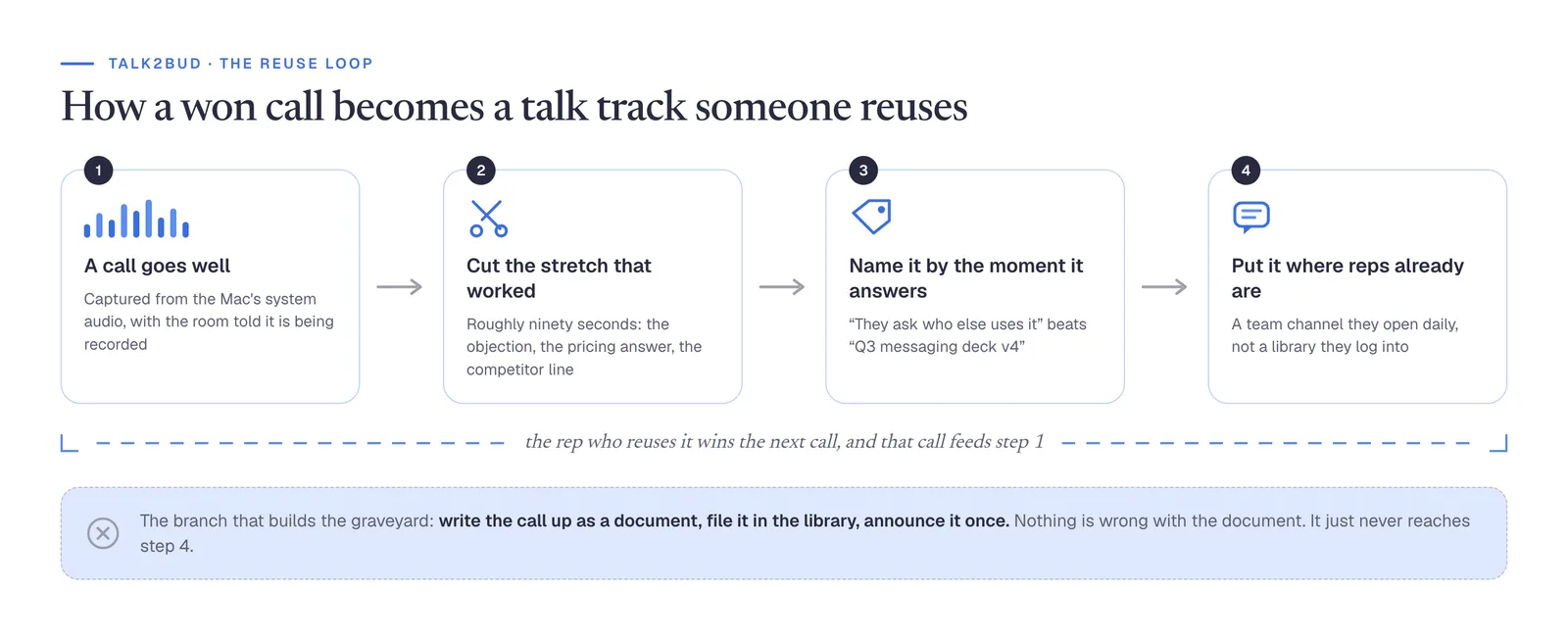
Step one, capture the call that went well. This is the step most programs skip, and skipping it is why enablement content ends up written from memory. The call has to be recorded to be reusable, and recording carries an obligation: tell the room. Capturing a call without a bot is different from capturing it in secret, and the honest version says the sentence out loud before anything else happens.
Step two, cut roughly ninety seconds. Not the full hour, not a highlight reel. The specific passage where the buyer pushed and the rep answered well. Gong's analysis of 67,149 recorded calls found the average rep responds to an objection with an unbroken 21.45-second monologue, while stronger reps pause, hold the back-and-forth, and ask before they answer. That difference is a behaviour with a rhythm to it, and a rhythm is close to impossible to transmit through a bullet point. Played, it teaches itself in the time it takes to read a paragraph.
Step three, name it after the moment it answers. "They ask who else our size uses it" is findable. "Q3 messaging deck v4" is archaeology. The name is the whole indexing strategy, and it is the difference between a rep searching and a rep remembering.
Step four, put it where reps already are. A channel the team opens daily beats a library the team logs into monthly. This is the step that decides the loop, because a clip nobody encounters is a document with better audio.
Then the loop closes on itself. The rep who reuses the line wins a call of their own, and that call is the next candidate for step one, which means the material refreshes as a by-product of selling instead of a content sprint. Qualification frameworks work the same way once evidence is the input: scoring BANT from what a buyer actually said beats scoring it from an impression an hour later.
One Objection, Start To Finish, At An Eleven-Rep Team
The team below is an example built to show the loop end to end, not a real account, and its numbers are illustrative rather than measured.
An eleven-rep team sells scheduling software into mid-market operations groups. Across a quarter, seven losses carry the same sentence in the notes: the buyer already owns a suite that "kind of does this." The head of sales does what most teams do first and commissions a battlecard. It runs six pages, it is accurate, it is announced in the Monday all-hands, and it is opened nine times in the first week and twice in the following six.
Now the loop version of the same problem.
Priya wins a deal in week two against that exact objection. Her call was captured, so the passage exists: at minute nineteen the buyer says the incumbent already covers scheduling, and instead of listing features, Priya asks which of their three teams currently books through it, then repeats the answer back and asks what happens when the answer is "only one." Eighty seconds, one question, one restatement. The manager cuts that passage, names it "They say their current suite already does this," and posts it in the team channel with two lines of context.
Three things happen in the next fortnight. Two reps replay it before similar calls and copy the question rather than the phrasing, which is the point. A third rep hits the objection in a different shape, from a buyer who owns the suite but hates it, and posts their own passage under the same name so the pair now sits together. The head of sales stops asking whether the battlecard was read and starts asking which clip a rep used, a question with an answer.
What the loop cost: about an hour a week of one manager's time, spent listening to the ends of won calls. What it produced by week six: four named passages, all from the team's own mouths, all dated, none of which needed a designer, a template or a launch note. The battlecard still exists, and it is now written from the four passages rather than from a positioning document, which is the only order in which the two artifacts make sense.
What The Critics Get Right About Software Sales Enablement
The case against this category is stronger than its vendors admit, and three of the charges hold.
It measures production because production is measurable. Assets published, courses completed, certifications passed: every one of those can be true in a quarter where no rep changed a single sentence they say. The adoption data above is the tell, since 55% of teams switching platforms cite low rep adoption, a metric that only shows up after the contract is signed.
The shelf carries a maintenance bill nobody staffs. Almost half of the enablement professionals in the 2025 survey said 40% or more of their content needs refreshing. Content decays because products ship, prices move and competitors reposition, so a library is a standing obligation. Passages from last month's won calls decay too, and they at least come with a date and a voice attached.
Bought capability is not adopted capability. Paying $50 or more per user for a platform whose features are 40% untouched is a familiar shape of waste, and it is the shape that makes finance suspicious of the whole function in the next downturn.
Where the criticism goes too far is the conclusion that enablement is theatre. A team without any of it has eleven private versions of the pitch and no way to tell which one wins. The fix is not a bigger library. It is a smaller unit of work with a shorter path to a rep's ears.
Turning Tuesday's Win Into Thursday's Talk Track
Running the loop above needs three things: the call captured, the call read against your own playbook, and the good part landing where the team already talks. Here is that sequence in talk2bud, which is a Mac app built for exactly this material.
- Capture the call from your own machine. talk2bud records the meeting from your Mac's system audio, so nothing joins the call as a participant and no attendee list grows by one. Recording without a bot is a different thing from recording in secret: you still tell the room, and the app's consent flow is explicit for that reason. Say the line at the top of the call, get the yes on the recording, and the passage you cut later is one you can share without a second thought.
- Read it against your playbook, not a generic template. A Lens in talk2bud is an analysis playbook for one meeting type, and your company's sales playbook can be the Lens: the questions your discovery is supposed to cover, the objections you expect, the next step you want agreed. At the end of the call, talk2bud evaluates the transcript against that Lens and hands back the read, which is where you find the passage worth keeping.
- Publish the passage to the team, not to a shelf. Channels are shared team spaces in talk2bud, so a chosen recording or analysis becomes visible to the group you pick, under a name you give it. One-to-ones are excluded from that by default, because the analysis of a private conversation belongs to the two people in it, not to a channel.
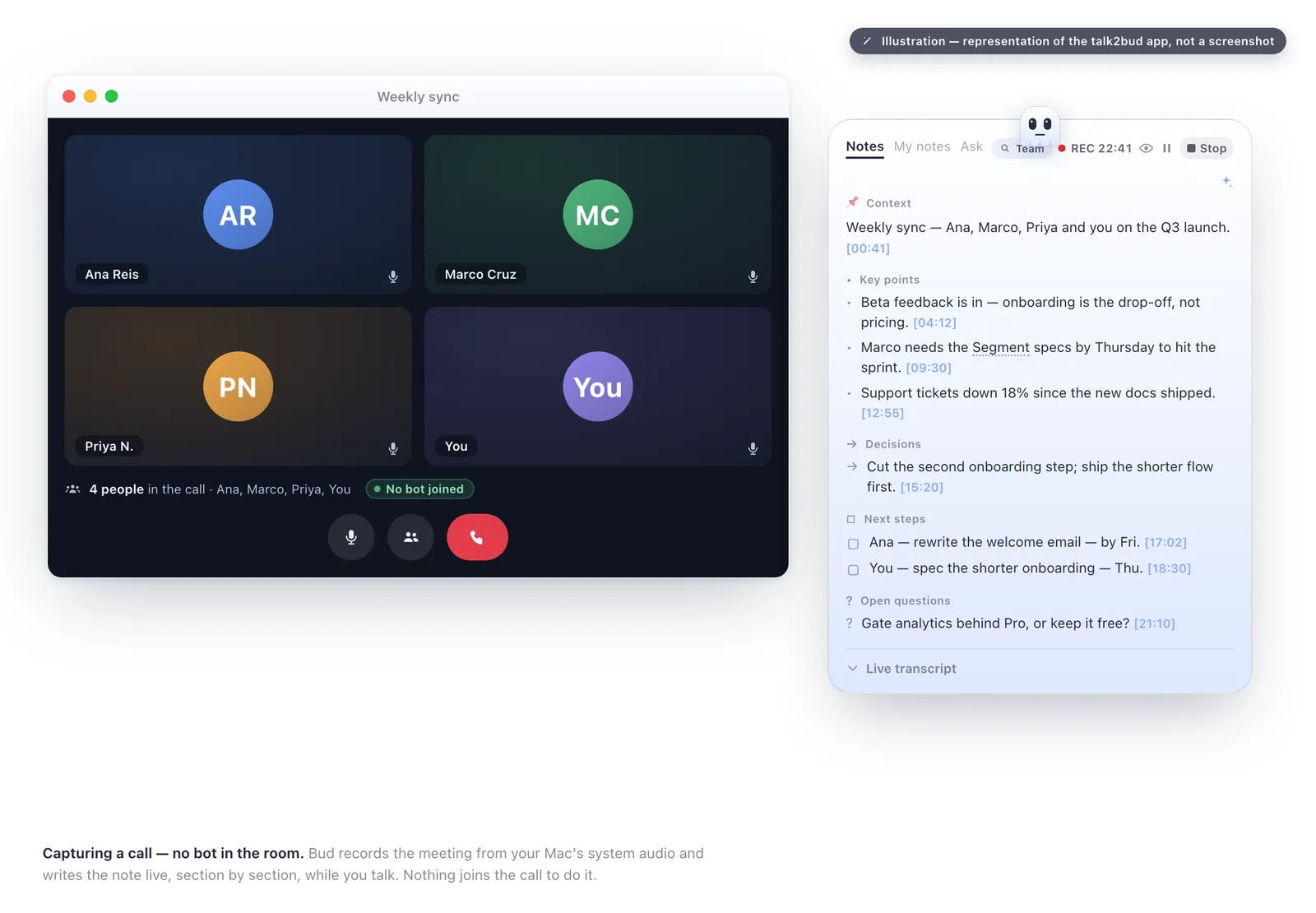
The app is English-only and Apple Silicon only, which is the focus that makes the capture side work the way it does: it is built to hold the conversation, not to be a browser tab that mirrors your CRM. Teams weighing the swap usually want two numbers, the platform bill they already pay and what talk2bud costs, and the comparison is worth doing with the per-seat figure from your current contract in front of you.
Three Signals That Say Reps Are Reusing It
Adoption reporting in this category tends to measure the wrong verb. Views are not reuse, and completions are not behaviour. Three signals are harder to fake.
Is the read being produced at all? Count the share of customer calls that end with an analysis against your Lens. If that number is under half, nothing downstream is real yet, because the raw material is still evaporating at the end of the day.
Does a named passage show up in later calls? This is audible. Pick one clip, wait two weeks, then check whether the question inside it appears in three other reps' recordings. A scoring pass makes this concrete, in the same way a client meeting scoring rubric turns "the call went well" into something two people grade the same way.
Does anyone reply? A clip posted to a channel that draws a question, a counter-example or a rival passage is alive. One that draws silence and a thumbs-up is a document with a waveform.
Questions Teams Ask Before They Start
What is sales enablement software?
Sales enablement software is a platform that stores sales content, runs training and coaching, and reports on what reps use with buyers. Most products in the category combine a content management layer, a learning management layer, and analytics that tie usage back to deals. The category is consolidating: Seismic and Highspot agreed to merge in February 2026, and Showpad and Bigtincan combined under Vector Capital in October 2025.
What's the difference between sales enablement and sales operations?
Sales enablement is responsible for what a rep can say and do in a conversation, so it ships talk tracks, coaching, onboarding and battlecards. Sales operations is responsible for the machinery around the deal, so it owns territories, compensation, CRM hygiene and forecasting. A quick test: if the fix changes what a buyer hears, it is enablement, and if it changes how the deal is recorded or routed, it is operations. In teams under about thirty people, both jobs usually sit with the same person.
Are sales enablement and revenue enablement platforms the same thing?
They are close, and the difference is scope rather than technology. Sales enablement serves the selling team, while revenue enablement extends the same content, training and coaching to every customer-facing role, including customer success, presales and marketing. The analyst firm Gartner renamed the category revenue enablement back in 2022, so many vendors now use the newer label for products that were sold as sales enablement platforms a few years ago.
Are sales enablement tools worth it for a small sales team?
For a team under roughly five reps, a dedicated enablement platform is rarely worth its price or its administration, because the knowledge still fits in a couple of heads and a shared channel. What is worth doing at that size is the habit underneath the tools: record your calls with consent, keep the ninety seconds where an objection was answered well, and name it so someone can find it. Teams generally start needing a platform when new hires arrive faster than the founders can sit in on calls.
How do I measure whether a sales enablement tool is actually working?
Measure reuse rather than production. Three signals work: what fraction of customer calls finish with a structured read against your playbook, whether a specific named talk track shows up in other reps' recorded calls within two weeks, and whether new hires reach their first won deal faster than the last cohort. Asset counts, course completions and login rates can all rise in a quarter where nothing a buyer hears has changed.
When A Program Is The Wrong Answer
Formal enablement has a floor below which it costs more than it returns, and the honest thing is to name it. Under about five reps with the founder still on most calls, the loop lives in one head and a program is overhead with a launch note attached. Before product-market fit, the winning message changes faster than you can codify it, so a library mostly manufactures stale material at speed. And when the loss reason is price or a missing feature, no talk track fixes it; the calls will tell you that plainly, which is its own kind of return.
Where none of those apply, the first move is small enough to do today, and it is one move rather than a plan. Take the last call your team won, find the passage where the objection got handled, cut about ninety seconds of it, name it after the objection, and post it where your reps already talk. If that clip gets reused before it gets discussed, you have a program worth building on, and capturing the calls it comes from is the only infrastructure it needs.
Verified August 2026 against the sources linked above: the Seismic and Showpad merger announcements, the 2025 Impact of Enablement report from Spekit and the Sales Enablement Collective, Gong's call analysis, and Gartner's definition of the category. The eleven-rep team is an example written to show the loop, and its figures are illustrative rather than measured.